Close
When you push the throttle forward and feel the hull lift onto plane, one question naturally comes to mind: how fast can a boat go before performance, safety, and efficiency start to clash?
Speed is one of the most discussed topics at any marina, yet the answer is rarely a single number. The true top speed of your vessel depends on hull design, engine output, weight distribution, and even the water conditions beneath you.
At Set Sail Boat Transport, we work with vessels across the entire performance spectrum, from leisure pontoons to offshore powerboats capable of impressive speeds. Understanding the limits of your vessel’s velocity helps you protect the hull, the propulsion system, and the long-term value of your investment.
Speed on the water is governed by hydrodynamics. The shape of your hull determines whether the boat pushes water aside or rises above it.
Displacement hulls move by pushing through the water, which creates significant drag as speed increases. These hulls are common on sailboats and trawlers and naturally limit top speed.
Planing hulls behave differently. As speed increases, hydrodynamic lift raises the hull partially out of the water. This reduces the amount of surface touching the water, dramatically lowering drag and allowing higher speeds.
This is why two boats with similar engine horsepower can produce completely different results on the water. A deep-V performance hull may reach speeds several times higher than a displacement cruiser using the same power output.
Boat speed varies dramatically depending on the vessel type and intended use. Some boats prioritize stability and comfort, while others are designed specifically for performance.
The table below shows common speed ranges across different popular categories.
Vessel Type | Average Top Speed (Knots) | Propulsion Type | Primary Limiting Factor |
Sailing Yacht | 6 – 10 | Wind / Auxiliary Diesel | Waterline length |
Pontoon Boat | 15 – 30 | Outboard Engine | Drag and buoyancy |
Center Console | 35 – 55 | Twin or Triple Outboards | Fuel flow and hull lift |
High-Performance Boat | 70 – 130+ | Inboard or surface drives | Prop pitch and hull aerodynamics |
Personal Watercraft | 45 – 65 | Jet propulsion | Impeller cavitation |
When people ask how fast their boat can go, they are usually thinking about high-performance craft. However, even moderate-speed boats can feel extremely fast when you are skimming across open water.
Many personal watercraft reach speeds above 60 knots, which is why owners rely on specialized jet ski transport when relocating these compact but powerful machines between waterways.
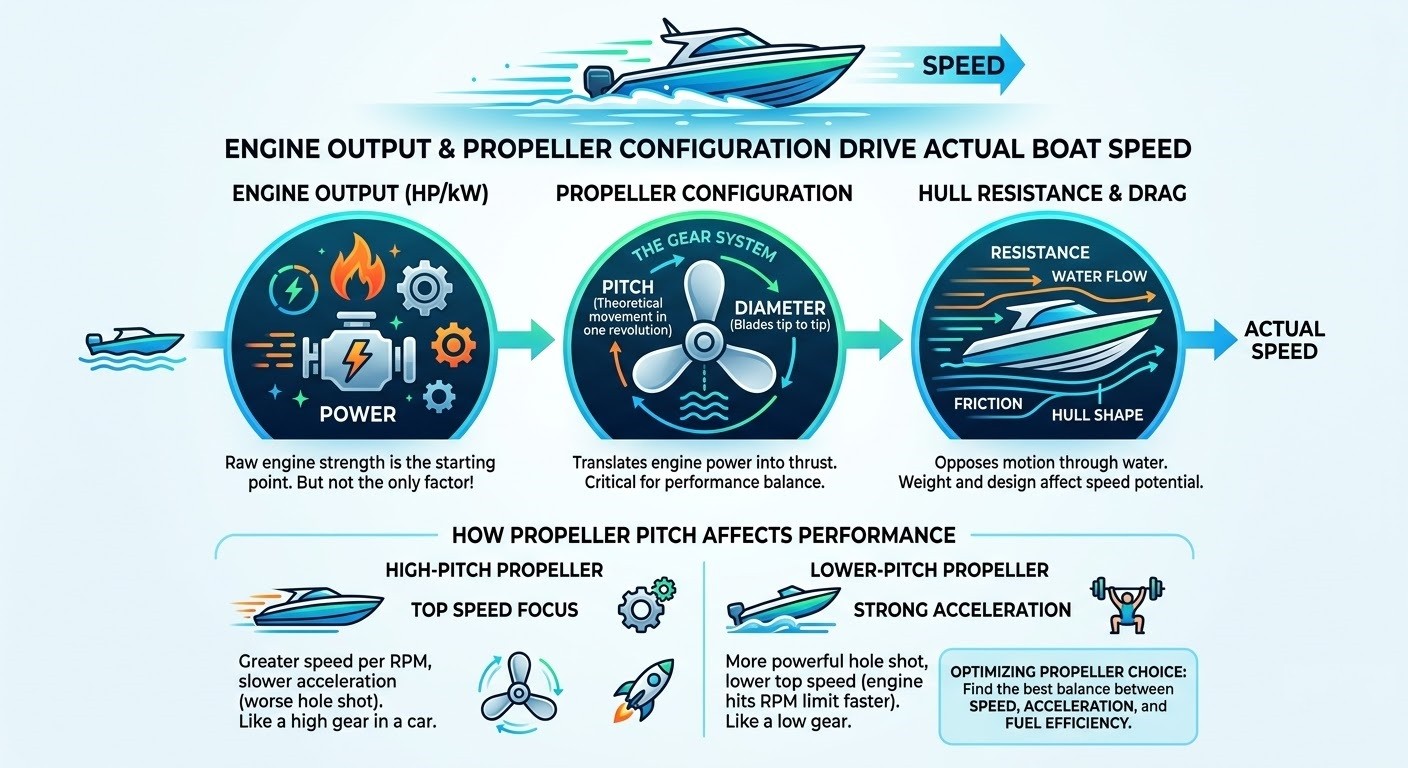
Horsepower alone does not determine your boat’s top speed. The relationship between engine output, propeller pitch, and hull resistance decides how efficiently that power is translated into forward motion.
A propeller works like a gear system in a vehicle. A higher-pitch propeller allows greater top speed but reduces acceleration. Lower-pitch props deliver strong acceleration but limit top-end velocity.
For example:
Choosing the correct propeller allows you to find the balance between speed and engine efficiency.
Even if your boat has a published top speed, real-world conditions produce very different results.
Several environmental factors affect performance:
Saltwater is denser than freshwater. This increased density creates more buoyancy, allowing the hull to ride slightly higher. In some cases, this can lead to marginally higher speeds.
Cooler air contains more oxygen, which helps engines burn fuel more efficiently. This is why your boat may feel faster during early morning runs compared to hot summer afternoons.
Headwinds and choppy water increase resistance dramatically. Even high-performance boats slow down significantly when navigating rough conditions.
Understanding these variables helps explain why how fast can a boat go often changes from one outing to the next.
Weight is one of the least known factors affecting boat speed. Every additional pound increases the hull’s displacement and reduces efficiency.
Common weight contributors include:
Even improper weight distribution can reduce speed. If too much weight sits near the stern, the bow rises excessively and creates drag. If the weight shifts too far forward, the boat may plow through water instead of riding on top of it.
Balanced weight distribution improves acceleration, fuel economy, and overall top speed.
Speed is an exciting part of boating, but it should always be balanced with safety and mechanical awareness. Knowing how fast can a boat go helps you respect the limits of your vessel while protecting the systems that keep it running reliably.
At Set Sailboat Transport, we help boat owners move their vessels across long distances without adding unnecessary hours, engine wear, or exposure to rough conditions. Our specialized hauling equipment ensures your boat arrives safely and ready for the water.
If you are planning to relocate your vessel to a new destination, contact us today for a professional boat shipping quote. Our experienced team will manage the logistics of your next long-distance haul!