Close
[vc_row][vc_column][vc_column_text css=""]Are you planning to move your sailboat and want to know about the cost to transport a 30-foot sailboat? It’s important to know the true price upfront because it can save you from unexpected surprises, whether it’s a short haul across the state or even overseas transportation.
At Set Sail Boat Transport, we believe in honesty. That’s why we have laid out the comparison between cross-country and local transportation and the factors that influence the total cost.
On average, the sailboat transport cost falls between $5 and $16 per mile. This cost depends on the transport method, distance, permits, and equipment that are needed. Smaller hauls may cost less per mile, but if your boat needs an oversized or complex move, the rate can go higher.
For example:
Transporting a sailboat across the country is very different from moving it locally, and the costs show that. The cost to transport a 30-foot sailboat cross-country usually ranges from $3,000 to $8,000. Again, it depends on distance, route complexity, and any permits that are required.
Local moves, on the other hand, are normally much cheaper. They often cost a few hundred to around $1,000 for short distances within the same state.
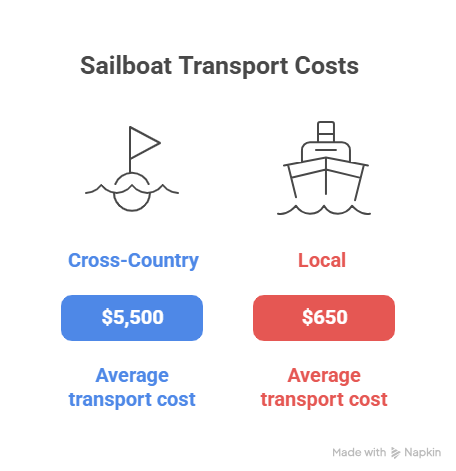
While local transport is simpler and cheaper, cross-country moves need careful planning, permits, and specialized equipment to make sure your sailboat arrives safely.
At Set Sail Boat Transport, we manage all the logistics for both types of moves with our boat transport services. This includes route planning, permits, escorts, and insurance.
You will likely need oversize permits, pilot cars, or restricted routes if your boat’s beam goes above the standard legal trailer width, which is often 8’6″. That adds to the cost.
Height matters as well since tall masts or wide booms can limit loading options or require mast removal.
Short hauls usually cost more per mile since fixed expenses like loading, permits, and setup are spread over fewer miles. Longer trips may reduce the per-mile rate, but the total cost stays high.
Routing also matters because remote locations, mountain routes, restricted bridges, or backhaul gaps can all increase the price.
Peak boating and hauling season in spring and early summer means that there will be fewer carriers available and the rates will be higher. Off-season moves can save you money.
We at Set Sail Boat Transport can help you plan your haul during a less busy window if your schedule is flexible.
Oversized loads may require you to have:
Any of these can raise the cost. For many 30-footers, mast stepping and unstepping or weight removal might be needed.
Make sure to factor in boat preparation, like removing loose gear, securing hatches, or draining tanks. You also need to include yard fees, launch charges, and any extra insurance your hauler requires.
At Set Sail Boat Transport, we discuss these details in advance so your quote is clear and honest.
[/vc_column_text][/vc_column][/vc_row][vc_row][vc_column][vc_tta_accordion][vc_tta_section title="1. How much does it cost per mile to transport a boat?" tab_id="1761943587137-13f70de8-a6d5"][vc_column_text css=""]The cost to transport a 30-foot sailboat depends on many factors. But you can expect around $5 to $16 per mile for the move itself, plus any preparation, permit, or escort fees.[/vc_column_text][/vc_tta_section][vc_tta_section title="2. Can you trailer a 30 ft boat?" tab_id="1761943587149-0e81f191-4d34"][vc_column_text css=""]
Yes, you can trailer a 30-foot boat, but it requires a heavy-duty truck, a specialized trailer, and oversize permits due to the boat’s width and height.[/vc_column_text][/vc_tta_section][vc_tta_section title="3. Can I reduce costs by doing some of the prep work myself?" tab_id="1761943702339-047ace76-c6c7"][vc_column_text css=""]Absolutely! Make sure your boat is ready by cleaning, draining, securing hatches, and removing gears. Doing this can reduce labor costs and may help your quote be more affordable.[/vc_column_text][/vc_tta_section][vc_tta_section title="4. Can my sailboat be transported with the mast up?" tab_id="1761943724549-1f15b3a8-783c"][vc_column_text css=""]Some 30-foot sailboats can be transported with masts up if the total height stays under 13.5 feet and local regulations permit it. We suggest that you remove the mast for safe and legal transport.[/vc_column_text][/vc_tta_section][vc_tta_section title="5. What's the cheapest time of year to transport a sailboat?" tab_id="1761943723384-a5b35538-f0b5"][vc_column_text css=""]The winter months, from November to March, usually bring the lowest transport rates because demand drops. But harsh weather in northern areas can cause delays. Fall and early spring often provide the best balance between fair pricing and smooth hauling conditions.[/vc_column_text][/vc_tta_section][/vc_tta_accordion][/vc_column][/vc_row][vc_row][vc_column][vc_column_text css=""]
Understanding the cost to transport a 30-foot sailboat helps you plan wisely and avoid expenses that can be heavy on your budget.
At Set Sail Boat Transport, we handle the entire sailboat transport for you, whether it’s a short move or a long-distance boat transportation. Our experienced haulers make sure your sailboat reaches its destination safely and on time.
Contact us today for a free quote and start your next boat shipping with us![/vc_column_text][/vc_column][/vc_row]
[vc_row][vc_column][vc_column_text css=""]Are you worried that shipping your boat will drain your savings? If you’ve ever wondered, “How much will shipping a boat cost?” you’re not alone. It’s true that the cost of transporting your boat from one point to another can add up quickly. But we can save you from that stress with some easy ways to keep those costs within your budget and still get your boat where it needs to go.
In this blog, you’ll find out the cheapest way to ship a boat and the cost-saving strategies to save money during boat transport.
When you’re moving your boat, the first big decision is how to do it. Figuring out which method fits you matters a lot because not all methods cost the same. Picking the right one is key to finding the cheapest way to ship a boat.
If you already own the trailer and a capable tow vehicle, hauling the boat yourself can be the lowest-cost option.
The pros: You’re in control, and you save the big carrier fee.
The cons: You must know how to tow safely and check the legal rules on width, height, and weight. Only use this method when you have the proper knowledge and expertise to handle the equipment, to avoid mishaps.
Hiring a professional means taking the stress off your shoulders. But it usually costs more than DIY boat hauling. You can still save money by choosing an off-peak season. For example, you can move your boat in early spring rather than during peak summer. Also, you can group your boat with others and choose easy-to-access pickup or drop-off locations.
The pros: Less stress, professional handling. You don’t need to worry about route planning or permits.
The cons: It’s generally more expensive than towing yourself, and costs can rise if your route is long, remote, or during peak season.
If your boat can handle high tides and water challenges, moving it on the water can be a wiser decision than shipping it on a big cargo ship. You may still have to pay for fuel, experienced staff, and you might face weather risks. With proper planning and a professional team, you can find out the cheapest way to ship a boat for certain routes.
The pros: You usually don’t need large trailers or permits. It’s perfect for coastal or nearby moves.
The cons: Weather delays and other factors can increase costs. You’ll also need to hire a qualified boat transport team if you’re not moving the boat yourself.
It’s generally the most expensive method, and most transporters opt for this when other options won’t work. It’s usually best when you have a very large boat, or for international routes. If you’re looking for the cheapest way to ship your boat, you can opt for this boat shipping method.
The pros: Safest and most convenient for large or luxury boats, especially for international moves. Minimal wear and tear on your vessel.
The cons: It’s comparatively more expensive and requires advance scheduling. This method is not ideal for short or domestic routes.
Here are five straightforward tips you can use:
You can protect your boat and save money by choosing a transporter who is honest, experienced, and transparent. At Set Sail Boat Transport, we’ve helped many owners make wise decisions, plan their route, and avoid costly mistakes. Consider reaching out to plan your move with us.
[/vc_column_text][/vc_column][/vc_row][vc_row][vc_column][vc_tta_accordion][vc_tta_section title="1. How can I save money on long distance boat transport?" tab_id="1761943587137-13f70de8-a6d5"][vc_column_text css=""]You can save money by shipping your boat yourself when you have a tow vehicle. But you have to make sure you take all the safety measures and plan a route that fits your trailer size.[/vc_column_text][/vc_tta_section][vc_tta_section title="2. What factors can affect the boat shipping costs?" tab_id="1761943587149-0e81f191-4d34"][vc_column_text css=""]There are many factors, including boat size, weight, route distance, and pick-up and drop-off locations. You might also have to pay extra fees if you require special permits in case your boat exceeds height or weight limitations.[/vc_column_text][/vc_tta_section][vc_tta_section title="3. Can I save money by moving my boat during off-peak season?" tab_id="1761943702339-047ace76-c6c7"][vc_column_text css=""]Yes, choosing less busy months means transporters have more availability and often lower rates, helping you access the cheapest way to ship a boat.[/vc_column_text][/vc_tta_section][vc_tta_section title="4. Should I always pick the lowest quote for boat transport?" tab_id="1761943724549-1f15b3a8-783c"][vc_column_text css=""]No, you should avoid that. Very low cost can lead to accidents or mishandling during transit, as the chances of unqualified staff and improper equipment increase.[/vc_column_text][/vc_tta_section][/vc_tta_accordion][/vc_column][/vc_row][vc_row][vc_column][vc_column_text css=""]
When you find the cheapest way to ship a boat, you won’t have to worry about paying expensive boat transport costs. If you'd like to discuss your route, boat size, and budget, Set Sail Boat Transport is here to assist. Contact us to get a personalized quote.
We focus on delivering value, safe handling, and offering cost-saving services. With experience, we’ve helped many boat owners stay within their budgets while transporting their boats, without compromising safety or proper care.[/vc_column_text][/vc_column][/vc_row]
[vc_row][vc_column][vc_column_text css=""]Isn’t it exciting to plan a sailing trip to new oceans? Let us tell you that planning to ship your sailboat involves a logistical challenge. You might be wondering, “Will boat shipping be safe?” How much will it have to pay?" We get it. These are the kinds of questions any boat owner will think of.
This blog can help you gain clarity if you have these questions as well. Read out to make your sailboat shipping experience both safe and budget-friendly so that you can enjoy the future adventures without any worries.
You generally have two options when you plan to move your sailboat. These include:
It can be the most suitable option when you’re moving your sailboat across states. Many boatowners also choose overland transportation when they move their boat to inland marinas where water routes aren’t available.
Let’s say, you’re sending your boat from the U.S to the Caribbean or any other long-distance hauls. That’s when sea transportation can be a good choice. Although it’s comparatively expensive, many boat owners prefer this method for its convenience and safe handling over long routes.
Here’s a table to help you understand the main differences:
| Feature | Overland Transportation | Sea Transportation |
| Best for | Short-distance or cross-state moves. | Long-distance or international shipping. |
| Boat Type | Small boats, trailerable vessels, removable masts. | Large yachts or non-trailerable boats |
| Cost | Generally more affordable for short distances | Higher overall costs due to port fees and ocean freight |
At Set Sail Boat Transport, we use dedicated equipment to ensure your vessel returns to you in the best condition, either via overland or sea transportation. Let our sailboat transport services handle everything from loading to delivery, so you can relax knowing that your boat will be returned to you in the same condition.
Many boat owners overlook preparation, without thinking that it can become a major cause of accidents or mishandling during sailboat shipping. These won’t only damage your vessel but also lead to unexpected costs and safety hazards.
Before transporting your boat, here are the key steps to prepare it safely:
When you plan your boat transport, it’s wise to understand the hidden costs and find ways to save money. Here’s what you should keep in mind:
Your main quote might not include extra charges such as port fees, craning costs, fuel surcharges, or customs duties. Keep in mind that these can increase your final costs if you do not clarify whether they are included in your quote. So, it’s always better to ask for a complete cost breakdown before you confirm a booking to avoid hidden expenses.
DIY preparation seems easy, right? But you should remember that all the preparation methods require expertise and knowledge. Since professionals conduct each process safely and efficiently, they reduce the risks of costly damage during transport.
If your schedule allows flexibility, you can share container space or trailer capacity with other boats to reduce sailboat shipping costs. This option works best for non-urgent relocations, as grouped shipments may take a little longer to organize.
Scheduling your boat transport during off-peak seasons or being open to flexible pickup and delivery dates can help you avoid premium rates charged during busy periods. Planning earlier also gives you more transporter options and better overall deals.
Choosing a shorter or more direct route minimizes the risks of mishandling and saves on fuel. Before finalizing your booking, ask your transporter about alternative routes or port options that could save both time and money.
You should always confirm what type of insurance coverage is included in your quote and whether it fully protects your boat against damage or weather-related incidents during transit. It will help you understand if you need to purchase additional marine transport insurance.[/vc_column_text][vc_single_image image="1497" img_size="500x500" alignment="center" css=""][vc_column_text css=""]
[/vc_column_text][/vc_column][/vc_row][vc_row][vc_column][vc_tta_accordion][vc_tta_section title="1. Can I transport my 30-foot sailboat myself?" tab_id="1761943587137-13f70de8-a6d5"][vc_column_text css=""]Yes, you can. Make sure you know how to handle the trailer and equipment, and that you have the right permits and a suitable route. Alternatively, you can opt for our sailboat transport services to ensure your vessel’s safety.[/vc_column_text][/vc_tta_section][vc_tta_section title="2. What is the cheapest way to ship a boat?" tab_id="1761943587149-0e81f191-4d34"][vc_column_text css=""]You can save money on boat shipping by towing it yourself. But we recommend opting for professional help, especially if you have a large vessel, because professional haulers know expert techniques that prevent mishandling and accidents during transit.[/vc_column_text][/vc_tta_section][vc_tta_section title="3. How can I prepare my boat for shipping?" tab_id="1761943702339-047ace76-c6c7"][vc_column_text css=""]You can begin by removing personal items, cleaning the hull, and disconnecting the batteries. Never forget to secure loose gear and check for leaks or damage. All these steps will help you prevent mishaps and accidents during transit.[/vc_column_text][/vc_tta_section][vc_tta_section title="4. How much does it cost to ship a boat per mile?" tab_id="1761943724549-1f15b3a8-783c"][vc_column_text css=""]On average, the costs per mile range from $5.00 to $16.00. However, you might have to pay more, depending on the size of your boat, the pickup & drop-off locations, and if you need pilot cars or additional cargo.[/vc_column_text][/vc_tta_section][/vc_tta_accordion][/vc_column][/vc_row][vc_row][vc_column][vc_column_text css=""]
In our view, shipping your sailboat doesn’t have to be stressful. You just need to plan properly with the right expertise. At Set Sail Boat Transport, we’ve helped many boat owners move their valuable boats safely, both cross-state and internationally.
From route planning to careful boat handling, we turn complex boat shipping situations into hassle-free and seamless boat moving journeys. Contact us to get a personalized quote for your boat adventure.[/vc_column_text][/vc_column][/vc_row]
[vc_row][vc_column][vc_column_text css=""]Moving your boat long distances can feel like a challenge. It does not matter if you’re relocating, buying a new vessel, or shifting to another marina. You want to make sure your boat and trailer reach the destination safely.
We know that shipping a boat and trailer involves more than just finalizing a carrier. You have to manage the preparation, inspection, and understanding of what to expect throughout the process.
In this blog, you will learn safe tips that can help you ensure shipping your boat and trailer isn’t nerve-racking.
You should not overlook this. When you plan to ship a boat and trailer, you might find both low-priced and expensive services. That’s when you have to make a mindful decision because low-budget doesn’t always deliver a positive result. That’s why we suggest getting multiple quotes to compare and get the best price for boat shipping services.
To give you an idea, here’s a breakdown of the average costs per mile:
| Distance Type | Average Price per Mile |
| Short Hauls under 100 miles | Around $5.00 to $8.00 |
| Medium Hauls around 100 to 500 miles | From $7.00 to $10.00 |
| Long Hauls about more than 500 miles | Between $10.00 and $16.00 |
You should remember that these prices may fluctuate based on your boat size, route, permits, and peak seasons. The good thing is, when you work with experienced carriers, you get transparent pricing and clear timelines.
Many people often overlook wheel bearings, but they keep your trailer rolling smoothly. If they’re not properly greased or are worn out, they can overheat and seize mid-trip.
If a bearing fails during the transit, it can damage the axle and delay delivery. Make sure you finalize all these things beforehand to save time and money.
Your trailer’s suspension will handle the weight and road vibration during transit. Leaf springs, axles, and bushings wear down over time, especially when you’re shipping larger and heavier boats.
Older trailers have more chances of corrosion, especially if you’re planning to launch in saltwater. So, it’s better to thoroughly inspect the frame.
If you’re uncertain about your trailer’s condition, a professional inspection is worth it. Set Sail Boat Transport’s experienced team has handled thousands of trailer inspections and can advise you on shipping a boat and trailer. Our goal is to keep your boat secure and your journey stress-free. Choose your next boat and trailer transportation with us.
Theft can be a natural concern, especially when you have to park your trailer overnight in a storage yard or wait for pickup. You should:
We always recommend securing the trailer during every stage of transport. It not only keeps your equipment safe but also gives you peace of mind.
Is your boat already insured? If so, you still need to confirm that you’re not forgetting the trailer’s paperwork. Just like other vehicles, carriers also require proper documentation to move your boat across states, or even when relocating to a different country.
You should have:
These rules differ depending on where your boat is going. So, it’s best to let professionals handle the transit with expertise. Set Sail Boat Transport has over 8 years of experience handling cross-country and nationwide boat transportation, so you don’t have to worry about a thing with our assistance.[/vc_column_text][vc_single_image image="1491" img_size="500x500" alignment="center" css=""][vc_column_text css=""]
Once your boat reaches its destination, don’t rush to launch. Take time to inspect everything before hitting the water.
Reinstall anything you removed before transport, like antennas, navigation gear, or propellers. If you had to remove the mast or arch, follow the same order in reverse. Double-check all connections and ensure your safety equipment is in place before shipping a boat and trailer.
[/vc_column_text][/vc_column][/vc_row][vc_row][vc_column][vc_tta_accordion][vc_tta_section title="1. How much does it cost to ship a boat and trailer?" tab_id="1761943587137-13f70de8-a6d5"][vc_column_text css=""]It typically ranges between $5.00 and $16.00 per mile, depending on distance, size, and route complexity.[/vc_column_text][/vc_tta_section][vc_tta_section title="2. Do I need insurance for my trailer during transport?" tab_id="1761943587149-0e81f191-4d34"][vc_column_text css=""]Yes, both your boat and trailer should be insured. Confirm coverage with your transport company and personal insurer.[/vc_column_text][/vc_tta_section][vc_tta_section title="3. How do I prepare my boat for transport?" tab_id="1761943702339-047ace76-c6c7"][vc_column_text css=""]Drain fuel and water tanks, secure loose gear, and remove valuable items. Always check your trailer for readiness.[/vc_column_text][/vc_tta_section][vc_tta_section title="4. Can I transport my boat internationally?" tab_id="1761943724549-1f15b3a8-783c"][vc_column_text css=""]Yes, but it involves customs, duties, and documentation. Professionals can help handle overseas requirements smoothly.[/vc_column_text][/vc_tta_section][/vc_tta_accordion][/vc_column][/vc_row][vc_row][vc_column][vc_column_text css=""]
At Set Sail Boat Transport, we can make your boat transport stress-free without compromising on your vessel’s security. With over eight years of industry experience, we have built a reputation for our expert boat and trailer handling.
Let us handle the boat shipping for you, so you sit back and relax knowing that your boat and trailer will arrive at the destination safely. Shipping a boat and trailer doesn’t have to feel complicated when you have experienced hands guiding the process. Contact our team today.[/vc_column_text][/vc_column][/vc_row]
[vc_row][vc_column][vc_column_text css=""]One of the first things that you will think about when you are planning to move your boat is, “How much will this cost?” Knowing the boat hauling cost per mile helps you plan your budget accordingly and avoid any problems later.
In 2025, moving a boat with Set Sail Boat Transport can cost anywhere from $5.00 to $16.00 per mile. The price can depend on multiple factors that we have discussed below. We recommend that you understand these aspects first before you decide to haul your boat.
Here are the six common factors that have an impact on calculating the boat hauling cost per mile. Being aware of them can help you plan and budget wisely.
The size and weight of your boat greatly impact the cost. Larger boats need more powerful trailers, sometimes specialized equipment, and extra handling, too. All of this increases the per-mile rate.
For example, a 25-foot sailboat may cost closer to $5 to $7 per mile, while a 40-foot yacht could range from $12 to $16 per mile.
Different boat types also affect hauling costs. Sailboats, motorboats, pontoon boats, and houseboats all have different handling requirements. Sailboat transport commonly needs careful mast removal and securing, whereas motorboats may need heavier-duty trailers.
You must understand the type of boat you have to help us decide the safest and most affordable transport method.
The location of pick-up and delivery is important. Boats that are picked up or delivered in urban areas with limited access may require extra handling or permits. This can raise costs.
If your pick-up or drop-off is in a remote area, it could increase the distance or require special equipment.
We might need pilot cars, bucket trucks, police escorts, or special permits to follow road rules if your boat is oversized. These things keep your boat safe, but can add to the boat hauling cost per mile.
Standard insurance normally covers the basic risks of moving your boat. But you might want extra cargo insurance if your boat is high-value. This adds a little to the boat hauling cost per mile, but it keeps your boat protected while we transport it.
Boat transport prices change with the seasons. In spring and summer, demand is high, so rates are usually higher. In fall and winter, prices are often lower and more competitive.
Another thing that affects cost is the type of transport you choose. Open or enclosed trailers.
This is the most common option and usually costs less. Your boat stays visible during the move, but it’s safe when we secure it properly. Open trailers work best for smaller boats or shorter trips.
This gives extra protection from weather, road debris, and possible damage on long hauls. It costs more per mile but is a good choice for high-value or delicate boats.
The right choice depends on your boat’s size, value, and how comfortable you are with exposure. We at Set Sail Boat Transport can help you pick the best option for your needs.[/vc_column_text][vc_single_image image="1488" img_size="500x500" alignment="center" css=""][vc_column_text css=""]
| Preparation Step | Key Action/Tip |
| Remove Loose Items | Take out all gear, electronics, and personal items from your boat. |
| Secure Hatches & Equipment | Make sure that hatches, doors, antennas, and masts are locked or strapped down. |
| Inspect Trailer | Check your trailer’s tires, lights, brakes, and hitch before the move. |
| Drain Fuel & Fluids | Keep fuel at a quarter tank or less and make sure there are no leaks. |
| Document Boat Condition | Take clear photos of your boat for insurance purposes. |
| Measure Your Boat | Note down your boat’s length, width, and height for transport. |
| Check Weather & Season | Plan around bad weather and road restrictions to avoid problems. |
| Protect Sensitive Areas | Wrap delicate areas and clearly label any fragile parts. |
| Plan Pick-Up & Drop-Off Access | Make sure that trucks can access pick-up and drop-off points and remove obstacles. |
| Communicate Special Instructions | Let us know about any special features your boat has so we can handle them safely. |
Set Sail Boat Transport has a great track record for reliable, nationwide boat transport services with over 8 years of experience.
When you work with us, you get:
[/vc_column_text][/vc_column][/vc_row][vc_row][vc_column][vc_tta_accordion][vc_tta_section title="1. How much do boat haulers charge per mile?" tab_id="1761943587137-13f70de8-a6d5"][vc_column_text css=""]We charge between $5.00 and $16.00 per mile. The price depends on your boat’s size, the route, and any extra services you need.[/vc_column_text][/vc_tta_section][vc_tta_section title="2. Are oversized boats more expensive to transport?" tab_id="1761943587149-0e81f191-4d34"][vc_column_text css=""]Yes. Boats that need pilot cars, police escorts, or special permits will cost more per mile.[/vc_column_text][/vc_tta_section][vc_tta_section title="3. How can I reduce my boat hauling costs?" tab_id="1761943702339-047ace76-c6c7"][vc_column_text css=""]You can save money if you are flexible with timing. Getting your boat ready before you leave also helps.[/vc_column_text][/vc_tta_section][vc_tta_section title="4. Should I use an open or enclosed trailer?" tab_id="1761943724549-1f15b3a8-783c"][vc_column_text css=""]Open trailers cost less and work well for regular boats and short trips. Enclosed trailers give more protection for high-value boats, but they cost more. Contact us today to get proper guidance.[/vc_column_text][/vc_tta_section][vc_tta_section title="5. Do seasonal changes affect cost?" tab_id="1761948595658-71027372-cf34"][vc_column_text css=""]Yes. Peak months like spring and summer have higher rates, while off-peak times can offer you more affordable prices.[/vc_column_text][/vc_tta_section][/vc_tta_accordion][/vc_column][/vc_row][vc_row][vc_column][vc_column_text css=""]
Knowing the boat hauling cost per mile in 2025 helps you plan your budget and saves you from unexpected charges. It also helps you pick the best way to move your boat.
We at Set Sail Boat Transport offer professional service for boats of all sizes. You can choose extra insurance, specific tools, and secure trailers to fit your needs.
Get in touch with us and get a free quote today for our boat transport services. We will handle your boat hauling with the best expertise, whether you are moving a small sailboat or a large yacht.[/vc_column_text][/vc_column][/vc_row]
[vc_row][vc_column][vc_column_text css=""]Moving your boat long distances isn’t just about going from one location to the next. It’s about getting there safely without any damage. That’s where overland transportation helps.
This method keeps it safe, whether you are moving or selling your boat. Set Sail Boat Transport has built a strong reputation for carefully moving boats across the country.
Our team brings a great understanding of overland boat transport with the latest equipment and best practices.
Overland transportation means moving your boat by road instead of by water or air. We use dedicated trailers and carriers. Plus, our qualified staff takes care of your boat from the moment we pick it up until it’s safely delivered.
It’s the perfect option when:
With our team at Set Sail Boat Transport, you get all the services you need, from route planning to secure loading.
Moving your boat overland sounds simple, but there are a few things you should watch out for. Once you know these problems, you can plan better and avoid any unexpected costs.
Larger boats may need special trailers or permits. Our team manages all the operations to ensure legal compliance and safe transport.
Low bridges, narrow roads, or sharp turns can create issues. We carefully plan routes to avoid obstacles and delays.
Snow, heavy rain, or strong winds can affect transport. While overland transport is safer than water in bad weather, timing and planning are extremely important.
Careless handling during loading or unloading can cause damage. Our experienced crew uses specialized equipment to secure your boat throughout the journey.
It’s really important for you to understand your coverage. At Set Sail Boat Transport, we provide insurance options so you are protected in any situation.[/vc_column_text][vc_single_image image="1485" img_size="500x500" alignment="center" css=""][vc_column_text css=""]
Moving a boat overland requires more than just putting it on a trailer. We follow strict protocols to keep it safe:
Thinking about moving your boat soon? Request a free quote today, and let’s plan your boat transport together.
We transport boats of every size and type, and we plan each move to keep them safe.
From luxurious yachts to small fishing boats, we take care of every vessel. Our custom-built trailers and hydraulic systems handle your boat professionally. If you are moving a yacht, our yacht transport services make sure you have everything under control, from lift to delivery.
For larger boats or special vessels, we use flatbed trucks and strong supports to move them safely. You can trust us to get them to their destination without any problems.
Here are some benefits that you get with overland transportation:
The cost of overland transport can depend on a few things. How far your boat needs to go, its size and weight, and the type of trailer or equipment needed are all factors that matter. Extra services like storage or faster shipping can also affect the price.
At Set Sail Boat Transport, we keep our pricing clear and simple. There are no additional charges or surprises. Once we know the details of your move, we give you a full quote and timeline so you know exactly what's coming your way.
[/vc_column_text][/vc_column][/vc_row][vc_row][vc_column][vc_tta_accordion][vc_tta_section title="1. What is the most economical way to transport a boat?" tab_id="1761943587137-13f70de8-a6d5"][vc_column_text css=""]The most economical way to move your boat is usually by towing it on a boat trailer. If you don’t have the right trailer or equipment, you can hire us for overland transport, which can save you money.[/vc_column_text][/vc_tta_section][vc_tta_section title="2. Can you hire someone to tow a boat?" tab_id="1761943587149-0e81f191-4d34"][vc_column_text css=""]Yes, you can hire a licensed and insured company like us to tow your boat safely. We have the right trailers, permits, and experience to make sure your move is secure.[/vc_column_text][/vc_tta_section][vc_tta_section title="3. What time of year is cheapest to move?" tab_id="1761943702339-047ace76-c6c7"][vc_column_text css=""]The cheapest time to move is usually during the off-season, which is late fall or winter. The demand is lower, and transport companies may offer better rates.[/vc_column_text][/vc_tta_section][vc_tta_section title="4. Is my boat insured during transport?" tab_id="1761943724549-1f15b3a8-783c"][vc_column_text css=""]Yes. At Set Sail Boat Transport, we provide insurance options to protect your boat throughout its journey.[/vc_column_text][/vc_tta_section][vc_tta_section title="5. What is the easiest boat trailer to use?" tab_id="1761948332330-b7b436b0-1122"][vc_column_text css=""]The easiest boat trailer to use is a bunk trailer. It has simple, supportive rails that guide your boat into place and make loading and unloading smooth. It is really useful for smaller to medium-sized boats.[/vc_column_text][/vc_tta_section][/vc_tta_accordion][/vc_column][/vc_row][vc_row][vc_column][vc_column_text css=""]
Overland transportation is one of the safest and most effective ways to move your boat. This method keeps your boat protected from the start, whether you are relocating, selling, or just moving it for maintenance.
Set Sail Boat Transport has been providing trusted and reliable service for every boat move for more than eight years. You can reach out to us any time and get your free quote today![/vc_column_text][/vc_column][/vc_row]
[vc_row][vc_column][vc_column_text css=""]Moving a pedal boat might look easy. But it can get damaged or become unsafe on the road if you don’t prepare for it properly.
In this guide, we will show you how to transport a pedal boat without worrying about it. We have been helping people with boat transport nationwide for over 8 years, so we know how to make your move simple.
Let’s go over the steps that you can follow to make the process easy.
A little preparation goes a long way before you start loading your pedal boat:
One of the first things you need to decide when moving your pedal boat is which equipment to use.
You need a trailer. This is usually the easiest option if your boat fits on a trailer you already have. Make sure the trailer can handle your boat’s weight and size.
A dolly or trolley can help you roll the boat into place for short moves, like from storage to a ramp. This is not meant for highway trips.
You may require a professional hauler or specialized transport. Hiring a boat transport company is a great choice if the trip is long or complicated. With so many years of knowledge and experience, Set Sail Boat Transport makes sure that your boat's move always remains reliable and secure.
This is the part where mistakes can happen. Let's take a look at how to transport a pedal boat using a trailer:
Securing your boat properly is very important. Here’s how we do it:
Run a checklist before the departure:
[/vc_column_text][vc_single_image image="1482" img_size="500x500" alignment="center" css=""][vc_column_text css=""]
Once on the road, how you drive tells as much as how you loaded:
When you arrive, take your time to unload the boat. Position the trailer near the water or unloading spot, and slide the boat off gently to avoid drops or snags. Once it’s off, check the hull and parts for any damage, and put back the seats, paddles, and other gear.
Learning how to transport a pedal boat safely means you should know each step, from prepping to unloading. You can keep your boat in great shape and enjoy a peaceful trip with the right gear, patience, and care. But it’s best to call in the professionals if you are in doubt.
Need help moving your pedal boat? Contact us at Set Sail Boat Transport, and we will show you how easy small boat transport can be. Get a quote today!
[/vc_column_text][/vc_column][/vc_row][vc_row][vc_column][vc_tta_accordion][vc_tta_section title="1. How to transport a pedal boat?" tab_id="1761943587137-13f70de8-a6d5"][vc_column_text css=""]To move your pedal boat, put it on a properly sized trailer or truck bed and secure it with padded straps. Remove loose items and drain water. Our expert team at Set Sail Boat Transport can do it safely for you.[/vc_column_text][/vc_tta_section][vc_tta_section title="2. Where should I attach tie-downs?" tab_id="1761943587149-0e81f191-4d34"][vc_column_text css=""]You can use strong points like the transom or other reinforced areas when securing pedals. Don’t rely on lightweight handles or seat edges.[/vc_column_text][/vc_tta_section][vc_tta_section title="3. Can I use rope instead of ratchet straps?" tab_id="1761943702339-047ace76-c6c7"][vc_column_text css=""]Using a rope isn’t the best idea. It can stretch, loosen, and won’t hold the right tension. We recommend using ratchet straps because they are safer and more reliable.[/vc_column_text][/vc_tta_section][vc_tta_section title="4. How fast can I tow a pedal boat?" tab_id="1761943724549-1f15b3a8-783c"][vc_column_text css=""]We usually suggest you drive below highway speeds, around 45‑55 mph, depending on conditions. Going slower helps reduce sway and gives you more control.[/vc_column_text][/vc_tta_section][vc_tta_section title="5. Can I load a pedal boat by myself?" tab_id="1761948041512-e2d90cdf-843d"][vc_column_text css=""]Yes, you can do it yourself if you have the right tools, like rollers, a winch, and some helpers. But for long trips or difficult setups, it’s best to let our experts show you how to transport a pedal boat safely and avoid mistakes.[/vc_column_text][/vc_tta_section][/vc_tta_accordion][/vc_column][/vc_row]
[vc_row][vc_column][vc_column_text css=""]When you need to move your sailboat across states, determining sailboat transport rates is the first step to avoid any surprises. Whether you are relocating, selling, or preparing for the winter season, knowing how these rates are calculated can save you from costly inconvenience.
Factors like distance, the size and weight of your boat, and the type of equipment required can bring the price up from a few hundred to several thousand dollars. However, if you understand the process beforehand, it saves you from problems.
[/vc_column_text][vc_single_image image="1475" img_size="500x500" alignment="center" css=""][vc_column_text css=""]There is no standard fixed rate for boat shipping, but there are some constant factors that every hauler considers when calculating the cost of transporting your sailboat:
The size of your boat is one of the biggest cost influencers in transport. The larger your boat is, the more time, labor, and handling it takes. Further, you cannot overlook the beam width while requesting a quote because it can require getting special permits or even escort vehicles.
For example, a 30-foot sailboat with a wide beam may require an extended trailer or pilot cars, while a compact 22-foot cruiser can often fit standard transport setups.
Longer trips often have a slightly lower cost per mile because carriers can get enough margin on long routes. That is why a 300-mile haul might cost less per mile than a 1,200-mile trip, but the total still is higher in the longer trip. Further, if your route crosses mountain ranges, narrow bridges, or busy metro areas, expect minor surcharges.
When you transport a boat, it’s usually done via truck and trailer, which we call overland transport in our industry term. This comes as the most common option because an open trailer is ideal for smaller or mid-sized sailboats, while a specialized cradle or carrier is required for larger boats.
If you’re planning to move a smaller vessel or trailerable sailboat, consider checking out a small boat transport service because it can be more affordable and faster to schedule.
In general, ranges between $1.50 and $4.00 per mile for standard road shipping. But depending on your boat size, location, and timing, that number can go as high as $5.00 to $16.00 per mile. Here is a breakdown to give you an idea:
| Boat Length | Average Weight | Distance | Estimated Price |
| 20 ft | 3,000 lbs | 500-mile trip | $750-$1,000 |
| 30 ft | 8,000 lbs | 800-mile trip | $2,500-$3,500 |
| 35 ft | 10,000-15,000 lbs | 1,200-mile trip | $4,500-$6,500 |
For your knowledge, there are around 11.96 million registered recreational boating vessels in the US. And seeing that number, it is easy to estimate why sailboat transport rates fluctuate across regions and seasons.
Most transport companies won’t move your vessel unless it’s ready to load. Here is what that means:
Also, note that transport companies don’t offer cleaning services. So, after a long boat hauling trip, your vessel will probably arrive dusty and require cleaning or detailing at your destination marina.
If you are still unsure what level of prep is required, a reputable sailboat transport service provider can walk you through it step-by-step.
Boat transport companies require special equipment, experience, and insurance coverage. Look for companies that:
However, delays can still happen because no company has control over the weather conditions, construction zones, or unexpected road closures. But in such situations, the right partner gives you transparency and peace of mind that your vessel is handled safely from dock to dock.
For general guidance or broader shipping needs, you can explore boat transport services that handle multiple vessel types across nationwide routes.
Here are a few extras that can influence the cost to ship:
Besides, if your route is a long distance, plan ahead for seasonal fluctuations. And the bottom line is always get multiple quotes and compare service details, not just price, because the cheapest is not always the safest.
[/vc_column_text][/vc_column][/vc_row][vc_row][vc_column][vc_tta_accordion][vc_tta_section title="What is the cheapest way to transport a boat?" tab_id="1761943587137-13f70de8-a6d5"][vc_column_text css=""]The cheapest way is usually open-trailer overland transport during off-peak seasons. Smaller boats that can fit standard trailers may even be towed by the owner if the vehicle allows it.[/vc_column_text][/vc_tta_section][vc_tta_section title="Can a 30-foot sailboat cross the Atlantic?" tab_id="1761943587149-0e81f191-4d34"][vc_column_text css=""]Yes, many 30-footers can reach safely if they are properly equipped. However, for relocations within the U.S., overland shipping is far safer and simpler.[/vc_column_text][/vc_tta_section][vc_tta_section title="Can a regular car tow a boat?" tab_id="1761943702339-047ace76-c6c7"][vc_column_text css=""]No, you need a truck or SUV with the right towing capacity for a boat.[/vc_column_text][/vc_tta_section][vc_tta_section title="How long does sailboat transport take?" tab_id="1761943724549-1f15b3a8-783c"][vc_column_text css=""]A few hundred miles may take two to three days; cross-country transport can take a week or more, depending on weather and permits.[/vc_column_text][/vc_tta_section][/vc_tta_accordion][/vc_column][/vc_row][vc_row][vc_column][vc_column_text css=""]
Shipping a sailboat is not about reaching from one place to another at the minimum price. It is about doing it safely, with reliable sailboat transport rates. Planning a budget while considering your investment safety helps you choose a company that values both precision and professionalism to move your boat.
At Set Sail Boat Transport, we have spent over eight years helping owners manage boat haulings. Our team specializes in secure overland hauling with clear communication, insurance-backed service, and on-time delivery whenever possible.[/vc_column_text][/vc_column][/vc_row]
[vc_row][vc_column][vc_column_text css=""]Understanding budgeting for boat hauling rates is essential when it comes to transporting your vessel. The job is not to hire someone to move from here to there, but involves multiple factors like boat size and route that count in the final cost. Knowing these things in advance can let you allocate the hauling budget more precisely.
In this guide, we will discuss the main considerations, average cost ranges, practical tips, and service options so you do not encounter unexpected surprises while budgeting the move. So, let’s dive into the details!
Boat hauling rates do not remain the same all the time and vary widely. For instance, if you have a small fishing boat, it may move across state lines for just a few dollars per mile. However, if you have a large yacht to move over a long distance, then it requires permits and pilot cars that can run into the hundreds per mile.
Further, the rates get influenced by factors like logistics, legal permits, and the specific needs of your boat. And it is also important to note here that while we aim to make timely deliveries, factors like weather delays, permit issues, and route changes cause delays because they are beyond our control, and preparing for these contingencies is a must when planning.
[/vc_column_text][vc_single_image image="1471" img_size="500x500" alignment="center" css=""][vc_column_text css=""]The boat transport costs depend on the following factors:
Keeping yourself aware of these factors allows you to understand why two similar-looking shipments can have different costs, while making your budget planning more precise.
The boat size is one of the dominating factors that determines the price. It plays a big role because a wider beam or taller boats require specific trailers, along with legal approvals. Here is how it goes:
Even a few inches of width increase in your boat can put it into the higher cost bracket. Therefore, when requesting quotes, measuring your boat, including beam, length, and height, is essential.
As we already mentioned, distance directly affects the quote because fuel and labor costs increase with it. Besides, the route characteristics play an equally important role here because overland transport for boats is not only about miles.
Look into the following factors for better clarity:
It is like if you are transporting a 30-foot powerboat from Florida to Texas, it may cost $2.00-$2.50 per mile, but these boat hauling rates can increase if the route includes tight mountain roads or bridge restrictions.
Heavy boats that are bigger than 40 feet require permits in many states. Along with that, some vessels need pilot cars or even police escorts to handle their transportation. These are included in a professional yacht transport service, but as separate line items, which you usually check mark when requesting a quote, like:
Clarifying which of these are included in your quote ensures you aren’t surprised by last-minute fees. Further, Federal guidance from the FHWA shows that states issue oversize/overweight permits for non-divisible loads, meaning that it would destroy the functionality if broken down. Also, note that national tracking of miles travelled under those permits is still not complete.
Loading and unloading impact both boat hauling rates and damage risk, and different companies handle this differently. Here is the basis of the process:
Here, you have to be very mindful because a little carelessness, like leaving a loose sail onboard, can increase the labor cost, along with high damage chances. Therefore, planning things beforehand protects your investment and reduces the final bill.
As mentioned previously, that season of spring or summer can hike the price, so you need to be aware of that when looking for a quote. Here, generally you will see a 10%-20% rise in the rate in the season time, while reduced rates in fall or winter.
Additionally, scheduling your boat hauling for a less busy season can also save money, but you have to ensure that the weather is safe for overland transport.
Here is a table mentioning average rates to expect when hauling a boat:
| Boat Size | Average Per-Mile Rate | Distance | Approximate Charges |
| Small boat. Less than 25 ft | $1.25-$5.00 | 200 miles | $250-$1,000 |
| Medium boat. Between 25-40 ft | $3.00-$10.00 | 300 miles | $900-$3,000 |
| Large yacht. Above 40 ft | $10.00-$16.00 | 400 miles | $4,000-$6,400 |
These rates include standard transportation but do not cover permits, pilot cars, or additional cargo insurance.
To get a precise quote, you need to follow the parameters as stated below:
If you own a fishing boat, dinghy, or other smaller boat, specialized small boat transport services can save money and simplify the process for you. With that, you get:
These services bring maximum efficiency without compromising safety.
Yacht transport services address challenges that are not present in a small boat. It includes:
All these are factors affecting pricing, including boat dimensions and route complexity.
You can rely on a boat transport service if you are looking for a mid-range solution that remains easy on your pocket, and caters to standard to oversized boats. Here is what you typically get with the general service:
If you want to save on your next boat hauling budget, keep the following things in mind:
These tips often reduce overall boat transport costs without compromising safety.
Even experienced carriers cannot control every variable. Therefore, you need to consider the following unexpected things that may appear while transporting your boat:
Despite all these challenges, professional boat hauling service providers communicate openly and help mitigate these issues. However, keep in mind that cleaning services are not included in this, as boats often get dusty or wet during cross-country transport. Therefore, scheduling cleaning at the receiving marina is recommended.
Insurance is the area that is often overlooked when budgeting for boat hauling. Even with experienced haulers and well-maintained equipment, accidents can happen because of debris on the road or sudden weather shifts. Therefore, understanding how your boat is protected during transport can prevent inconvenience later.
Besides, reputable carriers provide a baseline level of cargo insurance, but it may not cover the your boat full value. So, before your boat moves, ask for proof of insurance and clarity on things that are covered in insurance. Also, check your marina or storage facility requirements, as some require proof of liability coverage before releasing or accepting a vessel.
Finally, take detailed photos before pick-up, record the hull, propellers, and any visible equipment to create a verifiable record in case damage occurs during transit. Remember, insurance is not only paperwork but turns an unpredictable process into a managed one.
[/vc_column_text][/vc_column][/vc_row][vc_row][vc_column][vc_tta_accordion][vc_tta_section title="How much does it cost to have a boat hauled?" tab_id="1761943587137-13f70de8-a6d5"][vc_column_text css=""]The cost of boat hauling depends on the size, distance, and complexity. For an idea, a 20-foot fishing boat can cost $1.50–$2.00 per mile, and a 30-foot powerboat $2.00-$2.50 per mile.[/vc_column_text][/vc_tta_section][vc_tta_section title="What is the 10% rule for yachts?" tab_id="1761943587149-0e81f191-4d34"][vc_column_text css=""]The 10% Rule suggests budgeting 10% of your yacht's purchase for yearly maintenance and running costs. For instance, if your yacht costs you $500,000, then you roughly need $50,000 per year for its maintenance.[/vc_column_text][/vc_tta_section][vc_tta_section title="How do you get rid of a non-running boat?" tab_id="1761943702339-047ace76-c6c7"][vc_column_text css=""]You get rid of it by selling, donating, recycling, or disposing at a local landfill.[/vc_column_text][/vc_tta_section][vc_tta_section title="Can I transport a boat myself?" tab_id="1761943724549-1f15b3a8-783c"][vc_column_text css=""]Yes, but doing transport by yourself is risky. Using a professional boat transport service is safer because they have permits, insurance, trailers, and experience. Besides, they provide cost-effective solutions that are also convenient.[/vc_column_text][/vc_tta_section][/vc_tta_accordion][/vc_column][/vc_row][vc_row][vc_column][vc_column_text css=""]
Planning for boat hauling rates is not difficult if you follow the steps and precautions we discussed above. Meanwhile, the typical costs range from $5.00 to $16.00 per mile, depending on boat size, distance, and additional requirements. And proper preparation, like measuring boat beam, securing loose items, and choosing the right service, can prevent costly mistakes.
So, for those seeking reliable nationwide coverage, we at Set Sail Boat Transport are experienced carriers with over eight years of boat transportation experience. We treat your boats as our own, and that is why many owners trust us with their investment. We move your vessels safely, efficiently, and on schedule, whether it’s a small boat or a luxury yacht.[/vc_column_text][/vc_column][/vc_row]
[vc_row][vc_column][vc_column_text css=""]Does it feel like a huge task when you have to move your boat? You might be taking it to a new marina, sending it for repairs, or getting it ready for storage. For that, you need to know how to move a boat safely so you can keep it protected and follow the right rules.
We will explain both DIY and professional options in this guide. We will also share the correct methods and equipment that you need.
DIY transport can be a useful solution if you want to move a smaller boat. Here's how you can do it:
Make sure that you keep your boat ready for the trip before you start moving it:
You can use a boat ramp or a flat surface to load your boat onto the trailer. We recommend using a winch to pull it up slowly and safely. Make sure the boat sits in the center and stays balanced before you move it.
There are a few things we always recommend when you are towing your boat, especially if you are figuring out how to move a boat:
When you reach your destination, back the trailer into the water or onto a flat surface to unload the boat carefully. Take your time and make sure everything is steady.
DIY transport works best for smaller boats under 20 feet and for shorter trips. We also suggest checking your local rules before you travel because some areas may need special permits or have road limits.
Instead of learning how to move a boat yourself, it’s best to go with professional help if you have a larger boat or need to move it a long distance. We at Set Sail Boat Transport make the whole process easy and safe for you.
Here’s why working with us makes your boat move more easily:
You will need the right equipment to know how to move a boat. This keeps it safe, whether you are moving the boat yourself or hiring us to help.
[/vc_column_text][vc_single_image image="1467" img_size="500x500" alignment="center" css=""][vc_column_text css=""]
[/vc_column_text][/vc_column][/vc_row][vc_row][vc_column][vc_tta_accordion][vc_tta_section title="1. Do I need a special license to transport a boat?" tab_id="1761943587137-13f70de8-a6d5"][vc_column_text css=""]Yes, you might need a special license or permit. It depends on where you live and how big your boat is. We suggest that you check with your local authorities so you know exactly what’s required before you move it.[/vc_column_text][/vc_tta_section][vc_tta_section title="2. Can I transport a sailboat the same way as a powerboat?" tab_id="1761943587149-0e81f191-4d34"][vc_column_text css=""]Yes, you can, but sailboats need a bit more care because of their height and mast. We can help you with our sailboat transport services to make sure everything is done correctly.[/vc_column_text][/vc_tta_section][vc_tta_section title="3. What to use to move a boat?" tab_id="1761943702339-047ace76-c6c7"][vc_column_text css=""]You can use a strong boat trailer, a winch, and tight tie-down straps to move your boat safely. We recommend using professional transport equipment like hydraulic trailers or flatbed trucks if your boat is larger.[/vc_column_text][/vc_tta_section][vc_tta_section title="4. Can a regular car tow a boat?" tab_id="1761943724549-1f15b3a8-783c"][vc_column_text css=""]Usually, no. Most regular cars aren’t built to tow boats safely, especially if the boat is over 20 feet or very heavy. You will need a truck or SUV that has the right towing capacity for the job.[/vc_column_text][/vc_tta_section][vc_tta_section title="5. How much does it cost to move a 40-foot boat?" tab_id="1761943723384-a5b35538-f0b5"][vc_column_text css=""]Moving a 40-foot boat normally costs between $5.00 and $16.00 per mile. The price depends on the distance, equipment, permits, insurance, and how complex the route is.[/vc_column_text][/vc_tta_section][/vc_tta_accordion][/vc_column][/vc_row][vc_row][vc_column][vc_column_text css=""]
Knowing how to move a boat properly helps you protect your boat and follow the right rules. You need to have good planning and take safety steps, whether you want to move a small boat or a larger one.
We are here for you at Set Sail Boat Transport if you want professional help. We are experienced in boat moves that are safe, smooth, and on time.
Reach out to us today for boat transport services and get a free quote. Let our experts take care of the transportation so you can spend more time on the water.[/vc_column_text][/vc_column][/vc_row]