hacklink hack forum hacklink film izle hacklinkmaltepe escortmaltepe escortpadişahbetugwin288maltepe escortdeneme bonusubetofficebetofficedeneme bonusujojobetKeluaran sgpmeritkingdeneme bonusu
loader image
set sail logo no contact

[vc_row][vc_column][vc_column_text css=""]If you’ve ever asked yourself, “How much does boat towing cost?”, you’re not alone. The cost for towing a boat in 2025 isn't fixed. It can vary depending on the transport route and the distance your boat needs to cover. Additionally, the type of boat transport service you choose when you’re moving your boat across the state or relocating it from the marina to your home also matters.

Learning about the pricing helps you plan better, especially when you want to ensure your boat arrives safely without surprise fees or delays.

This guide can help you understand both on-water and road towing methods, covers cost factors, and explains how our team at Set Sail Boat Transport strives to deliver safe delivery of every boat.

Cost Comparison Between On-Water Towing and Road Towing

When figuring out how much does boat towing cost, it’s important to know the two main transport types, including on-water towing and road towing.

On-Water Towing

On-water towing means moving your boat across waterways using a towboat, barge, or specialized marine vessel. It’s ideal:

Factors That Affect On-Water Towing Rates

Road Towing

Road towing involves boat hauling on a specialized transport truck or a trailer from one location to another by road. It’s usually chosen by the transporters when there are no possible water routes. When you want to know how much does boat towing cost, you’ll see that road towing is effective for shorter distances and smaller boats. However, you have to keep in mind that you might have to obtain permits and expertise for your oversized loads.

Factors That Affect Road Towing Rates

Service TypePer-Mile CostsWhen It’s Most Appropriate
On-Water Towing$10.00 to $20.00When ports, lakes, or coastal routes connect pickup and delivery points
Road Towing$5.00 to $16.00When the boat cannot be moved on water because of no possible water routes

Set Sail Boat Transport can help you get accurate quotes and dependable delivery. Invest in our boat transportation services without worrying about the size of your boat or the distance you want it to cover.

Image showing the difference between on-water towing and road towing when learning about how much does boat towing cost.

How Set Sail Boat Transport Ensures Safe Delivery of Every Boat

It’s a natural phenomenon that everybody who hires a professional transporter expects their boat to be treated with care from start to finish. We at Set Sail Boat Transport deliver that confidence by combining experience, reliable logistics, and transparent communication.

Here’s how we strive to keep your boats safe:

This dedication to your boat’s safety has earned Set Sail Boat Transport a strong reputation among boat owners who value precision and peace of mind when they’re looking for how much does boat towing cost. When you choose us, you’re investing in the security of your boat.

Frequently Asked Questions

[/vc_column_text][/vc_column][/vc_row][vc_row][vc_column][vc_tta_accordion][vc_tta_section title="1. How much does towing a small boat cost?" tab_id="1761943587137-13f70de8-a6d5"][vc_column_text css=""]For small boats under 20 feet, you can expect $5.00 to $10.00 per mile, depending on distance and regional fuel rates.[/vc_column_text][/vc_tta_section][vc_tta_section title="2. How much is boat towing for long-distance road transport?" tab_id="1761943587149-0e81f191-4d34"][vc_column_text css=""]Long hauls generally range from $8.00 to $15.00 per mile due to permits, labor, and higher fuel usage.[/vc_column_text][/vc_tta_section][vc_tta_section title="3. How much does boat towing cost for waterway routes?" tab_id="1761943702339-047ace76-c6c7"][vc_column_text css=""]On-water towing may range from $8.00 to $15.00 per mile. However, the rate increases with distance when you need to obtain additional permits, pay for extra labor, and incur higher fuel usage.[/vc_column_text][/vc_tta_section][vc_tta_section title="4. What factors affect the cost of boat towing?" tab_id="1761943724549-1f15b3a8-783c"][vc_column_text css=""]The total cost depends on several factors, including boat size and weight, towing distance, terrain or water conditions, time of day, and regional fuel rates. Emergency or off-hour towing may also require you to pay higher rates.[/vc_column_text][/vc_tta_section][/vc_tta_accordion][/vc_column][/vc_row][vc_row][vc_column][vc_column_text css=""]

Final Thoughts

Finding out how much does boat towing cost helps you plan in advance, compare quotes, and choose the service that fits your needs. Both on-water and road towing offer reliable ways to move your boat, but prices vary based on distance, location, and the type of your vessel. The main thing is to find a company that values transparency, safety, and professionalism.

If you’re preparing to move your boat this season, don’t wait until the last minute. Request your personalized quote from Set Sail Boat Transport today and make your next boat towing experience smooth and worry-free.[/vc_column_text][/vc_column][/vc_row]

[vc_row][vc_column][vc_column_text css=""]Transporting your boat can seem like a lot to handle, but it all starts with finding your answer to “how is a boat measured?” It’s one of the crucial steps, as you can get accurate shipping quotes and avoid costly mistakes when you have exact measurements of your boat. Since every boat has unique dimensions, knowing them enables you to prepare for a safe and compliant transport.

Knowing how to measure a boat is just as important when you’re buying one as when you’re transporting it. Accurate measurements of the boat’s length, width, and height help you make sure it fits comfortably at your dock, on your trailer, or in your storage space before you make the purchase.

Let’s break down how you can measure your boat correctly before purchasing a boat or booking a hauling service.

Know the Standard Measurement Points & Dimensions

Image describing the factors that help understand how is a boat measured

When it comes to transporting your boat, here are some measurements that matter most. These can affect the type of trailer, route, and permits needed for safe transportation.

Length Overall (LOA)

LOA is the first thing that you’ll come to know when you’re learning about how a boat is measured. It refers to the total length of your boat, from the very tip of the bow to the furthest point at the stern.

Keep in mind that even a few inches can make a difference in the kind of permits required. If your boat has removable parts, like an extendable platform, it’s best to measure both with and without those accessories.

Beam (Width)

It’s the widest part of your boat, which is measured from side to side at the broadest point. Getting this measurement right is important when you’re figuring out how is a boat measured. That’s because most states have width restrictions for road transport. Remember that radar arches, bimini tops, rub rails, and other accessories often increase the beam.

At Set Sail Boat Transport, we make sure you have the full dimensions of your boat to plan the safest, most compliant route. When you avail our boat transportation services, we’ll handle the details, so you can stay relaxed knowing that your boat is in expert hands from pickup to delivery.

Height and Air Draft

Height is often the most misunderstood measurement in boat shipping. You should know that it’s not just the boat’s height. Once, one of our clients told us that their sailboat’s mast couldn’t be lowered. We then figured out that the possible solution was special routing because the boat’s overall height had increased due to the mast.

Finding your boat’s height will help the transport team choose a trailer that keeps your boat within safe limits.

Dry Weight

When you learn how a boat is measured, you’ll notice a term called dry weight. It is:

Why Are Accurate Boat Measurements Necessary?

Keeps Your Boat Safe on the Road

When you know how a boat’s exact size is measured, you can plan transport safely, avoid clearance issues, and make sure it’s loaded securely for the journey.

Helps You Avoid Costly Mistakes

Accurate measurements save you from damage during transport and prevent you from buying a boat that’s too big for your trailer or storage space.

Makes Dock and Storage Planning Easier

By measuring your boat’s length, width, and height, you’ll know right away whether it will fit at your dock, marina, or in your garage.

Makes Transport Permits and Route Planning Simple

When you provide the right dimensions, it’s easier for transporters to plan routes, get permits, and make sure your boat reaches its destination safely.

Lets You Make the Right Purchase

Knowing the measurements helps you compare options confidently and buy a boat that fits your lifestyle, space, and future transport needs perfectly.

Frequently Asked Questions

[/vc_column_text][/vc_column][/vc_row][vc_row][vc_column][vc_tta_accordion][vc_tta_section title="1. How is a boat measured for transport?" tab_id="1761943587137-13f70de8-a6d5"][vc_column_text css=""]You measure the total length, width, and height, including fixed accessories that can’t be removed.[/vc_column_text][/vc_tta_section][vc_tta_section title="2. What’s the difference between height and air draft?" tab_id="1761943587149-0e81f191-4d34"][vc_column_text css=""]Height measures the full structure on a trailer. Air draft measures from the waterline to the highest fixed point.[/vc_column_text][/vc_tta_section][vc_tta_section title="3. Why is weight important when shipping a boat?" tab_id="1761943702339-047ace76-c6c7"][vc_column_text css=""]It determines the trailer type and permit requirements. It also ensures safety during hauling.[/vc_column_text][/vc_tta_section][vc_tta_section title="4. How can I find my boat’s dry weight?" tab_id="1761943724549-1f15b3a8-783c"][vc_column_text css=""]Check your owner’s manual or manufacturer’s website for the dry weight listed in your model specifications.[/vc_column_text][/vc_tta_section][/vc_tta_accordion][/vc_column][/vc_row][vc_row][vc_column][vc_column_text css=""]

Wrapping it Up

Knowing how is a boat measured helps you plan a smoother, safer boat shipping experience. If you’re ready to ship your boat, don’t leave measurements to chance. Take a few minutes to record them accurately, then reach out to our specialists, who will handle the rest.

With Set Sail Boat Transport, you get expertise, communication, and peace of mind. Our commitment to professionalism and customer-first service ensures your vessel is handled with care from start to finish.[/vc_column_text][/vc_column][/vc_row]

[vc_row][vc_column][vc_column_text css=""]You should be careful when thinking about boat shipping coast-to-coast. It can get heavy on your budget if you don’t have the right information.

It is a long journey, roughly 2,200 to 2,800 miles. You need to understand the cost to ship a boat from Florida to California and the factors that can cause the pricing to fluctuate.

At Set Sail Boat Transport, we have handled many cross-country boat moves, and we know what it takes to calculate costs, secure permits, and make sure that your boat arrives safely.

In this guide, we will explain pricing, compare trailer transport types, and go through state-specific rules.

What Influences Transport Costs?

Before we talk about the boat transport cost, we need to first understand what really influences it.

We all know that distance is the main thing to consider, but apart from that, what are the other factors that affect the cost to ship a boat from Florida to California?

On average, the rates can range from $5 to $16 per mile according to all these factors.

How to Estimate the Cost to Ship a Boat from Florida to California

We have written down sample estimates based on boat size and transport complexity to give you an idea:

Rate per mile: $5 to $6

It will cost you $12,500 if your boat travels 2,500 miles.

Rate per mile: $7 to $10

It will cost you between $17,500 and $25,000 if your boat travels 2,500 miles.

Rate per mile: $10 to $16

It will cost you between $25,000 and $40,000 if your boat travels 2,500 miles.

These are just rough figures. Of course, the cost depends on your boat’s size, permits, insurance, etc., but there are more factors that affect actual costs. We have discussed them for you below.

Florida and California Boat Transport Rules You Must Know

Knowing the rules of both Florida and California will help you understand how the cost is calculated and where you might need to pay extra. Let's quickly go through the points:

Florida

California

Cost to ship a boat from Florida to California

Is Open Trailer Transport Better or Enclosed Trailer Transport?

Choosing the right boat trailer type can affect both cost and safety. Here’s a quick comparison:

Open Trailer Transport

Open transport is a popular choice for many boat owners because it’s more affordable and easily available, and it also gives you faster scheduling. It’s a practical option when you want to move your boat quickly and without going over your budget.

But it does have a few downsides. Your boat remains exposed to weather, debris, and road dirt throughout the trip. This brings a little bit of risk of minor cosmetic damage.

Overall, this method works best for small- to mid-size boats, aluminum boats, or sailboats with removable rigging.

Enclosed Trailer Transport

Enclosed transport gives your boat the highest level of protection during transit. It covers your vessel from weather, road debris, and even minor bumps that can happen along the way. This option is the best for luxury yacht transport or boats with sensitive electronics.

The only drawback is the cost. Enclosed transport is more expensive, and it may require specialized equipment to handle larger or custom builds.

Still, it’s the top choice for high-value boats, large sportfishing yachts, or vessels that demand extra care.

Choosing between the two really comes down to your budget, the value of your boat, and how much risk you are willing to take. At Set Sail Boat Transport, we help you pick the best transport option according to your vessel’s size, build, and handling needs.

FAQs

[/vc_column_text][/vc_column][/vc_row][vc_row][vc_column][vc_tta_accordion][vc_tta_section title="1. How does Set Sail Boat Transport handle oversized boats?" tab_id="1761943587137-13f70de8-a6d5"][vc_column_text css=""]We carefully pick the right trailer according to your boat’s measurements. Every oversized transport receives a customized plan designed for safety and compliance.[/vc_column_text][/vc_tta_section][vc_tta_section title="2. What kind of communication can I expect during transport?" tab_id="1761943587149-0e81f191-4d34"][vc_column_text css=""]When you book a boat move with us, you’ll get regular calls, texts, and photo updates showing pickup, progress, and delivery status. Our goal is to keep you fully informed every step of the way.[/vc_column_text][/vc_tta_section][vc_tta_section title="3. What are the average costs for the boat towing service?" tab_id="1761943702339-047ace76-c6c7"][vc_column_text css=""]Prices depend on your boat size, route distance, and the type of transport service you choose. On average, boat towing might range between $5.00 and $16.00.[/vc_column_text][/vc_tta_section][vc_tta_section title="4. How long does a boat transport usually take?" tab_id="1761943724549-1f15b3a8-783c"][vc_column_text css=""]The duration of your transit can vary depending on the route, the distance your boat needs to cover, and the weather conditions. We provide an estimated delivery time before the trip begins and keep you updated throughout the journey.[/vc_column_text][/vc_tta_section][/vc_tta_accordion][/vc_column][/vc_row][vc_row][vc_column][vc_column_text css=""]

Contact Us for Smooth Boat Towing

When it comes to finding the best boat towing service, you should look for expertise, strong safety standards, and transparent communication. At Set Sail Boat Transport, we’re proud to meet those expectations and exceed them.

Our team is veteran-owned and dedicated to transporting each boat with care and precision. We value your boat as much as you do. Contact us today and let our experienced team make your next boat move simple, safe, and worry-free.[/vc_column_text][/vc_column][/vc_row]

[vc_row][vc_column][vc_column_text css=""]You should be careful when thinking about boat shipping coast-to-coast. It can get heavy on your budget if you don’t have the right information.

It is a long journey, roughly 2,200 to 2,800 miles. You need to understand the cost to ship a boat from Florida to California and the factors that can cause the pricing to fluctuate.

At Set Sail Boat Transport, we have handled many cross-country boat moves, and we know what it takes to calculate costs, secure permits, and make sure that your boat arrives safely.

In this guide, we will explain pricing, compare trailer transport types, and go through state-specific rules.

What Influences Transport Costs?

Before we talk about the boat transport cost, we need to first understand what really influences it.

We all know that distance is the main thing to consider, but apart from that, what are the other factors that affect the cost to ship a boat from Florida to California?

On average, the rates can range from $5 to $16 per mile according to all these factors.

How to Estimate the Cost to Ship a Boat from Florida to California

We have written down sample estimates based on boat size and transport complexity to give you an idea:

Rate per mile: $5 to $6

It will cost you $12,500 if your boat travels 2,500 miles.

Rate per mile: $7 to $10

It will cost you between $17,500 and $25,000 if your boat travels 2,500 miles.

Rate per mile: $10 to $16

It will cost you between $25,000 and $40,000 if your boat travels 2,500 miles.

These are just rough figures. Of course, the cost depends on your boat’s size, permits, insurance, etc., but there are more factors that affect actual costs. We have discussed them for you below.

Florida and California Boat Transport Rules You Must Know

Knowing the rules of both Florida and California will help you understand how the cost is calculated and where you might need to pay extra. Let's quickly go through the points:

Florida

California

Cost to ship a boat from Florida to California

Is Open Trailer Transport Better or Enclosed Trailer Transport?

Choosing the right boat trailer type can affect both cost and safety. Here’s a quick comparison:

Open Trailer Transport

Open transport is a popular choice for many boat owners because it’s more affordable and easily available, and it also gives you faster scheduling. It’s a practical option when you want to move your boat quickly and without going over your budget.

But it does have a few downsides. Your boat remains exposed to weather, debris, and road dirt throughout the trip. This brings a little bit of risk of minor cosmetic damage.

Overall, this method works best for small- to mid-size boats, aluminum boats, or sailboats with removable rigging.

Enclosed Trailer Transport

Enclosed transport gives your boat the highest level of protection during transit. It covers your vessel from weather, road debris, and even minor bumps that can happen along the way. This option is the best for luxury yacht transport or boats with sensitive electronics.

The only drawback is the cost. Enclosed transport is more expensive, and it may require specialized equipment to handle larger or custom builds.

Still, it’s the top choice for high-value boats, large sportfishing yachts, or vessels that demand extra care.

Choosing between the two really comes down to your budget, the value of your boat, and how much risk you are willing to take. At Set Sail Boat Transport, we help you pick the best transport option according to your vessel’s size, build, and handling needs.

FAQs

[/vc_column_text][/vc_column][/vc_row][vc_row][vc_column][vc_tta_accordion][vc_tta_section title="1. What is the cost to ship a boat from Florida to California?" tab_id="1761943587137-13f70de8-a6d5"][vc_column_text css=""]The cost ranges from $5 to $16 per mile. This is an average range that depends on your boat’s size, weight, route complexity, and any required permits or pilot cars.[/vc_column_text][/vc_tta_section][vc_tta_section title="2. How long does it take to ship a boat from Florida to California?" tab_id="1761943587149-0e81f191-4d34"][vc_column_text css=""]Normally, it takes around 7 to 14 days, but again, it depends on how much labor goes into transporting your boat, its size, the route, and the stops.[/vc_column_text][/vc_tta_section][vc_tta_section title="3. Can I transport my boat partially by water?" tab_id="1761943702339-047ace76-c6c7"][vc_column_text css=""]In some cases, hybrid transport can reduce costs. Reach out to us so we can advise you accordingly.[/vc_column_text][/vc_tta_section][vc_tta_section title="4. Does the quote include insurance?" tab_id="1761943724549-1f15b3a8-783c"][vc_column_text css=""]A reputable hauler includes standard cargo insurance. Additional coverage can be added for high-value boats.[/vc_column_text][/vc_tta_section][/vc_tta_accordion][/vc_column][/vc_row][vc_row][vc_column][vc_column_text css=""]

Conclusion

Planning the transport and calculating the cost to ship a boat from Florida to California is not a small task. It's a big move, and you need to plan properly and choose the right hauling partner for it.

At Set Sail Boat Transport, our crew maps out the safest and most efficient route for your boat. We coordinate with state authorities for smooth transit and give you the latest updates so that you stay content throughout your boat’s transport.

Contact Set Sail Boat Transport today for a free quote and expert guidance for your coast-to-coast boat move.[/vc_column_text][/vc_column][/vc_row]

[vc_row][vc_column][vc_column_text css=""]You will realize that there is no single answer that works for every angler when you start looking for the best fishing boats. It all depends on where you are fishing and what kind of experience you want on the water.

At Set Sail Boat Transport, we not only help you choose the right type of fishing boat but also make sure it gets delivered safely. You can count on our team for a reliable and smooth transport service, whether it’s a small lake boat or a luxury sportfisher.

Why Is It Important to Choose the Right Fishing Boat?

The right fishing boat changes everything. It affects how far you can go and how comfortable your trips are. The top-rated fishing boats offer you practicality, performance, and stability. They are built to handle long days on the water without giving up comfort or safety.

If you are new to this, we understand the confusion you might be going through. We have narrowed down some popular boat types to help you decide which one suits your fishing routine the most.

Types of Best Fishing Boats and Their Models

The "best" boat is very subjective and depends totally on your fishing style, preferred environment, and budget. Let’s have a look at the different types below:

1. Center Console Boats

Center consoles are known for their incredible versatility, and they are also considered the iconic fishing machine.

2. Bay Boats

Bay boats are built for shallow-water fishing in bays, estuaries, and flats. They offer a perfect balance between inshore performance and a smoother ride compared to a pure flats boat.

3. Bass Boats

Bass boats are the best fishing boats for freshwater tournament fishing because they are built for speed, stealth, and pinpoint control on lakes and rivers.

4. Dual Console Boats

Dual console boats are more versatile than a center console. They provide seating and protection in both the bow and stern and usually feature open access to the windshield.

5. Walkarounds and Express Cruisers

These boats offer both fishing features and luxuries like cabins, galleys, and heads. They are a good choice for overnight trips or longer excursions.

A diagram showing five types of best fishing boats: Bass, Bay, Dual Console, Center Console, and Walkaround.

How Boat Size Affects Your Fishing Experience

Size matters a lot in how your boat performs. Here’s a quick overview of common fishing boat sizes and what they are best for:

Boat SizeIdeal UseExample Models
Under 20 ftLakes, rivers, and calm bays.Lund 1875 Impact XS, Tracker Pro Team 195 TXW.
20 to 30 ftInshore and nearshore fishing.Boston Whaler 280 Outrage, Robalo R272.
30 to 40 ftOffshore sportfishing and longer trips.Everglades 355 CC, Grady-White Canyon 336.
40 ft and upDeep-sea and tournament fishing.Viking 44 Convertible, Hatteras GT45X

2 Types of Options to Transport Your Fishing Boat

There are two types of transport options you can consider when it comes to moving your boat.

Overland Transport

Coastal or Water Transport

Transporting a boat along the coast or through inland waterways is possible, but it carries more risks. Weather, waves, tides, and marine traffic can cause delays and harm the hull, rigging, or electronics.

At Set Sail Boat Transport, we specialize in overland transport for the best fishing boats because it offers the safest and most reliable way to move your vessel.

Helpful Tips for Transporting Your Fishing Boat Safely

Our team can also help you with preparation checklists through our boat transport services if you own multiple vessels or need storage planning.

FAQs

[/vc_column_text][/vc_column][/vc_row][vc_row][vc_column][vc_tta_accordion][vc_tta_section title="1. Which boat brand is most reliable?" tab_id="1761943587137-13f70de8-a6d5"][vc_column_text css=""]Brands like Boston Whaler, Grady-White, and Lund are considered the most reliable because of their durable build, safety features, and ongoing performance.[/vc_column_text][/vc_tta_section][vc_tta_section title="2. What boat is least likely to capsize?" tab_id="1761943587149-0e81f191-4d34"][vc_column_text css=""]Boston Whaler boats are quite famous for their “unsinkable” design. This makes them least likely to capsize even in rough water conditions.[/vc_column_text][/vc_tta_section][vc_tta_section title="3. What boats do pro fishermen use?" tab_id="1761943702339-047ace76-c6c7"][vc_column_text css=""]Pro fishermen mostly use bass boats or center console boats from brands like Ranger, Skeeter, Viking, or Everglades.[/vc_column_text][/vc_tta_section][vc_tta_section title="4. What is the most affordable fishing boat?" tab_id="1761943724549-1f15b3a8-783c"][vc_column_text css=""]Aluminum fishing boats are usually the most affordable option. Models like the Tracker Pro Team or Lund Angler are great for beginners and weekend anglers.[/vc_column_text][/vc_tta_section][/vc_tta_accordion][/vc_column][/vc_row][vc_row][vc_column][vc_column_text css=""]

Wrapping Up

The best fishing boats come in all sizes. What really matters is finding the right balance between your fishing style, budget, and comfort.

At Set Sail Boat Transport, we make sure your fishing boat reaches you safely, wherever it’s coming from. Our experienced team manages pick-up, permits, insurance, delivery, and any other step that is essential in moving your boat.

Get in touch today for a free quote, and let us take care of your small boat transport![/vc_column_text][/vc_column][/vc_row]

[vc_row][vc_column][vc_column_text css=""]Are you planning to move your sailboat and want to know about the cost to transport a 30-foot sailboat? It’s important to know the true price upfront because it can save you from unexpected surprises, whether it’s a short haul across the state or even overseas transportation.

At Set Sail Boat Transport, we believe in honesty. That’s why we have laid out the comparison between cross-country and local transportation and the factors that influence the total cost.

How Is Your Boat Transport Cost Estimated?

On average, the sailboat transport cost falls between $5 and $16 per mile. This cost depends on the transport method, distance, permits, and equipment that are needed. Smaller hauls may cost less per mile, but if your boat needs an oversized or complex move, the rate can go higher.

For example:

Cross-Country vs. Local Sailboat Transport Costs

Transporting a sailboat across the country is very different from moving it locally, and the costs show that. The cost to transport a 30-foot sailboat cross-country usually ranges from $3,000 to $8,000. Again, it depends on distance, route complexity, and any permits that are required.

Local moves, on the other hand, are normally much cheaper. They often cost a few hundred to around $1,000 for short distances within the same state.

Cost to transport a 30-foot sailboat

Cross-Country Transport

Local Transport

While local transport is simpler and cheaper, cross-country moves need careful planning, permits, and specialized equipment to make sure your sailboat arrives safely.

At Set Sail Boat Transport, we manage all the logistics for both types of moves with our boat transport services. This includes route planning, permits, escorts, and insurance.

5 Main Factors That Affect the Cost to Transport a 30-Foot Sailboat

1. Beam Width and Height Clearance

You will likely need oversize permits, pilot cars, or restricted routes if your boat’s beam goes above the standard legal trailer width, which is often 8’6″. That adds to the cost.

Height matters as well since tall masts or wide booms can limit loading options or require mast removal.

2. Route and Distance

Short hauls usually cost more per mile since fixed expenses like loading, permits, and setup are spread over fewer miles. Longer trips may reduce the per-mile rate, but the total cost stays high.

Routing also matters because remote locations, mountain routes, restricted bridges, or backhaul gaps can all increase the price.

3. Season and Demand

Peak boating and hauling season in spring and early summer means that there will be fewer carriers available and the rates will be higher. Off-season moves can save you money.

We at Set Sail Boat Transport can help you plan your haul during a less busy window if your schedule is flexible.

4. Additional Equipment and Permits

Oversized loads may require you to have:

Any of these can raise the cost. For many 30-footers, mast stepping and unstepping or weight removal might be needed.

5. Insurance and Preparation

Make sure to factor in boat preparation, like removing loose gear, securing hatches, or draining tanks. You also need to include yard fees, launch charges, and any extra insurance your hauler requires.

At Set Sail Boat Transport, we discuss these details in advance so your quote is clear and honest.

FAQs

[/vc_column_text][/vc_column][/vc_row][vc_row][vc_column][vc_tta_accordion][vc_tta_section title="1. How much does it cost per mile to transport a boat?" tab_id="1761943587137-13f70de8-a6d5"][vc_column_text css=""]The cost to transport a 30-foot sailboat depends on many factors. But you can expect around $5 to $16 per mile for the move itself, plus any preparation, permit, or escort fees.[/vc_column_text][/vc_tta_section][vc_tta_section title="2. Can you trailer a 30 ft boat?" tab_id="1761943587149-0e81f191-4d34"][vc_column_text css=""]
Yes, you can trailer a 30-foot boat, but it requires a heavy-duty truck, a specialized trailer, and oversize permits due to the boat’s width and height.[/vc_column_text][/vc_tta_section][vc_tta_section title="3. Can I reduce costs by doing some of the prep work myself?" tab_id="1761943702339-047ace76-c6c7"][vc_column_text css=""]Absolutely! Make sure your boat is ready by cleaning, draining, securing hatches, and removing gears. Doing this can reduce labor costs and may help your quote be more affordable.[/vc_column_text][/vc_tta_section][vc_tta_section title="4. Can my sailboat be transported with the mast up?" tab_id="1761943724549-1f15b3a8-783c"][vc_column_text css=""]Some 30-foot sailboats can be transported with masts up if the total height stays under 13.5 feet and local regulations permit it. We suggest that you remove the mast for safe and legal transport.[/vc_column_text][/vc_tta_section][vc_tta_section title="5. What's the cheapest time of year to transport a sailboat?" tab_id="1761943723384-a5b35538-f0b5"][vc_column_text css=""]The winter months, from November to March, usually bring the lowest transport rates because demand drops. But harsh weather in northern areas can cause delays. Fall and early spring often provide the best balance between fair pricing and smooth hauling conditions.[/vc_column_text][/vc_tta_section][/vc_tta_accordion][/vc_column][/vc_row][vc_row][vc_column][vc_column_text css=""]

Final Thoughts

Understanding the cost to transport a 30-foot sailboat helps you plan wisely and avoid expenses that can be heavy on your budget.

At Set Sail Boat Transport, we handle the entire sailboat transport for you, whether it’s a short move or a long-distance boat transportation. Our experienced haulers make sure your sailboat reaches its destination safely and on time.

Contact us today for a free quote and start your next boat shipping with us![/vc_column_text][/vc_column][/vc_row]

[vc_row][vc_column][vc_column_text css=""]Are you worried that shipping your boat will drain your savings? If you’ve ever wondered, “How much will shipping a boat cost?” you’re not alone. It’s true that the cost of transporting your boat from one point to another can add up quickly. But we can save you from that stress with some easy ways to keep those costs within your budget and still get your boat where it needs to go.

In this blog, you’ll find out the cheapest way to ship a boat and the cost-saving strategies to save money during boat transport.

What’s the Cheapest Way to Ship My Boat?

When you’re moving your boat, the first big decision is how to do it. Figuring out which method fits you matters a lot because not all methods cost the same. Picking the right one is key to finding the cheapest way to ship a boat.

Hauling the Boat Yourself

If you already own the trailer and a capable tow vehicle, hauling the boat yourself can be the lowest-cost option.

The pros: You’re in control, and you save the big carrier fee.

The cons: You must know how to tow safely and check the legal rules on width, height, and weight. Only use this method when you have the proper knowledge and expertise to handle the equipment, to avoid mishaps.

Professional Overland Hauler

Hiring a professional means taking the stress off your shoulders. But it usually costs more than DIY boat hauling. You can still save money by choosing an off-peak season. For example, you can move your boat in early spring rather than during peak summer. Also, you can group your boat with others and choose easy-to-access pickup or drop-off locations.

The pros: Less stress, professional handling. You don’t need to worry about route planning or permits.

The cons: It’s generally more expensive than towing yourself, and costs can rise if your route is long, remote, or during peak season.

On-Water Delivery

If your boat can handle high tides and water challenges, moving it on the water can be a wiser decision than shipping it on a big cargo ship. You may still have to pay for fuel, experienced staff, and you might face weather risks. With proper planning and a professional team, you can find out the cheapest way to ship a boat for certain routes.

The pros: You usually don’t need large trailers or permits. It’s perfect for coastal or nearby moves.

The cons: Weather delays and other factors can increase costs. You’ll also need to hire a qualified boat transport team if you’re not moving the boat yourself.

Yacht Transport Ship

It’s generally the most expensive method, and most transporters opt for this when other options won’t work. It’s usually best when you have a very large boat, or for international routes. If you’re looking for the cheapest way to ship your boat, you can opt for this boat shipping method.

The pros: Safest and most convenient for large or luxury boats, especially for international moves. Minimal wear and tear on your vessel.

The cons: It’s comparatively more expensive and requires advance scheduling. This method is not ideal for short or domestic routes.

Strategies to Move Your Boat Affordably

Here are five straightforward tips you can use:

You can protect your boat and save money by choosing a transporter who is honest, experienced, and transparent. At Set Sail Boat Transport, we’ve helped many owners make wise decisions, plan their route, and avoid costly mistakes. Consider reaching out to plan your move with us.

Frequently Asked Questions

[/vc_column_text][/vc_column][/vc_row][vc_row][vc_column][vc_tta_accordion][vc_tta_section title="1. How can I save money on long distance boat transport?" tab_id="1761943587137-13f70de8-a6d5"][vc_column_text css=""]You can save money by shipping your boat yourself when you have a tow vehicle. But you have to make sure you take all the safety measures and plan a route that fits your trailer size.[/vc_column_text][/vc_tta_section][vc_tta_section title="2. What factors can affect the boat shipping costs?" tab_id="1761943587149-0e81f191-4d34"][vc_column_text css=""]There are many factors, including boat size, weight, route distance, and pick-up and drop-off locations. You might also have to pay extra fees if you require special permits in case your boat exceeds height or weight limitations.[/vc_column_text][/vc_tta_section][vc_tta_section title="3. Can I save money by moving my boat during off-peak season?" tab_id="1761943702339-047ace76-c6c7"][vc_column_text css=""]Yes, choosing less busy months means transporters have more availability and often lower rates, helping you access the cheapest way to ship a boat.[/vc_column_text][/vc_tta_section][vc_tta_section title="4. Should I always pick the lowest quote for boat transport?" tab_id="1761943724549-1f15b3a8-783c"][vc_column_text css=""]No, you should avoid that. Very low cost can lead to accidents or mishandling during transit, as the chances of unqualified staff and improper equipment increase.[/vc_column_text][/vc_tta_section][/vc_tta_accordion][/vc_column][/vc_row][vc_row][vc_column][vc_column_text css=""]

Conclusion

When you find the cheapest way to ship a boat, you won’t have to worry about paying expensive boat transport costs. If you'd like to discuss your route, boat size, and budget, Set Sail Boat Transport is here to assist. Contact us to get a personalized quote.

We focus on delivering value, safe handling, and offering cost-saving services. With experience, we’ve helped many boat owners stay within their budgets while transporting their boats, without compromising safety or proper care.[/vc_column_text][/vc_column][/vc_row]

[vc_row][vc_column][vc_column_text css=""]Isn’t it exciting to plan a sailing trip to new oceans? Let us tell you that planning to ship your sailboat involves a logistical challenge. You might be wondering, “Will boat shipping be safe?” How much will it have to pay?" We get it. These are the kinds of questions any boat owner will think of.

This blog can help you gain clarity if you have these questions as well. Read out to make your sailboat shipping experience both safe and budget-friendly so that you can enjoy the future adventures without any worries.

What’s Better Between Overland And Sea Transportation?

You generally have two options when you plan to move your sailboat. These include:

Overland Transportation:

It can be the most suitable option when you’re moving your sailboat across states. Many boatowners also choose overland transportation when they move their boat to inland marinas where water routes aren’t available.

Sea Transportation:

Let’s say, you’re sending your boat from the U.S to the Caribbean or any other long-distance hauls. That’s when sea transportation can be a good choice. Although it’s comparatively expensive, many boat owners prefer this method for its convenience and safe handling over long routes.

Here’s a table to help you understand the main differences:

FeatureOverland TransportationSea Transportation
Best forShort-distance or cross-state moves.Long-distance or international shipping.
Boat TypeSmall boats, trailerable vessels, removable masts.Large yachts or non-trailerable boats
CostGenerally more affordable for short distancesHigher overall costs due to port fees and ocean freight

At Set Sail Boat Transport, we use dedicated equipment to ensure your vessel returns to you in the best condition, either via overland or sea transportation. Let our sailboat transport services handle everything from loading to delivery, so you can relax knowing that your boat will be returned to you in the same condition.

Safety Pre-Shipping Preparation

Many boat owners overlook preparation, without thinking that it can become a major cause of accidents or mishandling during sailboat shipping. These won’t only damage your vessel but also lead to unexpected costs and safety hazards.

Before transporting your boat, here are the key steps to prepare it safely:

Cost-Effective Strategies for Sailboat Shipping

When you plan your boat transport, it’s wise to understand the hidden costs and find ways to save money. Here’s what you should keep in mind:

Watch out for Additional Costs

Your main quote might not include extra charges such as port fees, craning costs, fuel surcharges, or customs duties. Keep in mind that these can increase your final costs if you do not clarify whether they are included in your quote. So, it’s always better to ask for a complete cost breakdown before you confirm a booking to avoid hidden expenses.

Choose between DIY and Professional Boat Preparation

DIY preparation seems easy, right? But you should remember that all the preparation methods require expertise and knowledge. Since professionals conduct each process safely and efficiently, they reduce the risks of costly damage during transport.

Opt for Shared Sailboat Transport Options

If your schedule allows flexibility, you can share container space or trailer capacity with other boats to reduce sailboat shipping costs. This option works best for non-urgent relocations, as grouped shipments may take a little longer to organize.

Schedule the Transportation During the Off-Season

Scheduling your boat transport during off-peak seasons or being open to flexible pickup and delivery dates can help you avoid premium rates charged during busy periods. Planning earlier also gives you more transporter options and better overall deals.

Plan Efficient Routes

Choosing a shorter or more direct route minimizes the risks of mishandling and saves on fuel. Before finalizing your booking, ask your transporter about alternative routes or port options that could save both time and money.

Verify the Type of Insurance Coverage

You should always confirm what type of insurance coverage is included in your quote and whether it fully protects your boat against damage or weather-related incidents during transit. It will help you understand if you need to purchase additional marine transport insurance.[/vc_column_text][vc_single_image image="1497" img_size="500x500" alignment="center" css=""][vc_column_text css=""]

Frequently Asked Questions

[/vc_column_text][/vc_column][/vc_row][vc_row][vc_column][vc_tta_accordion][vc_tta_section title="1. Can I transport my 30-foot sailboat myself?" tab_id="1761943587137-13f70de8-a6d5"][vc_column_text css=""]Yes, you can. Make sure you know how to handle the trailer and equipment, and that you have the right permits and a suitable route. Alternatively, you can opt for our sailboat transport services to ensure your vessel’s safety.[/vc_column_text][/vc_tta_section][vc_tta_section title="2. What is the cheapest way to ship a boat?" tab_id="1761943587149-0e81f191-4d34"][vc_column_text css=""]You can save money on boat shipping by towing it yourself. But we recommend opting for professional help, especially if you have a large vessel, because professional haulers know expert techniques that prevent mishandling and accidents during transit.[/vc_column_text][/vc_tta_section][vc_tta_section title="3. How can I prepare my boat for shipping?" tab_id="1761943702339-047ace76-c6c7"][vc_column_text css=""]You can begin by removing personal items, cleaning the hull, and disconnecting the batteries. Never forget to secure loose gear and check for leaks or damage. All these steps will help you prevent mishaps and accidents during transit.[/vc_column_text][/vc_tta_section][vc_tta_section title="4. How much does it cost to ship a boat per mile?" tab_id="1761943724549-1f15b3a8-783c"][vc_column_text css=""]On average, the costs per mile range from $5.00 to $16.00. However, you might have to pay more, depending on the size of your boat, the pickup & drop-off locations, and if you need pilot cars or additional cargo.[/vc_column_text][/vc_tta_section][/vc_tta_accordion][/vc_column][/vc_row][vc_row][vc_column][vc_column_text css=""]

Choose Set Sail Boat Transport for Sailboat Shipping

In our view, shipping your sailboat doesn’t have to be stressful. You just need to plan properly with the right expertise. At Set Sail Boat Transport, we’ve helped many boat owners move their valuable boats safely, both cross-state and internationally.

From route planning to careful boat handling, we turn complex boat shipping situations into hassle-free and seamless boat moving journeys. Contact us to get a personalized quote for your boat adventure.[/vc_column_text][/vc_column][/vc_row]

[vc_row][vc_column][vc_column_text css=""]Moving your boat long distances can feel like a challenge. It does not matter if you’re relocating, buying a new vessel, or shifting to another marina. You want to make sure your boat and trailer reach the destination safely.

We know that shipping a boat and trailer involves more than just finalizing a carrier. You have to manage the preparation, inspection, and understanding of what to expect throughout the process.

In this blog, you will learn safe tips that can help you ensure shipping your boat and trailer isn’t nerve-racking.

Get Multiple Price Quotes

You should not overlook this. When you plan to ship a boat and trailer, you might find both low-priced and expensive services. That’s when you have to make a mindful decision because low-budget doesn’t always deliver a positive result. That’s why we suggest getting multiple quotes to compare and get the best price for boat shipping services.

To give you an idea, here’s a breakdown of the average costs per mile:

Distance TypeAverage Price per Mile
Short Hauls under 100 milesAround $5.00 to $8.00
Medium Hauls around 100 to 500 milesFrom $7.00 to $10.00
Long Hauls about more than 500 milesBetween $10.00 and $16.00

You should remember that these prices may fluctuate based on your boat size, route, permits, and peak seasons. The good thing is, when you work with experienced carriers, you get transparent pricing and clear timelines.

Check the Trailer’s Wheel Bearing

Many people often overlook wheel bearings, but they keep your trailer rolling smoothly. If they’re not properly greased or are worn out, they can overheat and seize mid-trip.

If a bearing fails during the transit, it can damage the axle and delay delivery. Make sure you finalize all these things beforehand to save time and money.

Make Sure the Suspension System Is in Smooth Condition

Your trailer’s suspension will handle the weight and road vibration during transit. Leaf springs, axles, and bushings wear down over time, especially when you’re shipping larger and heavier boats.

Inspect Signs of Rust or Corrosion

Older trailers have more chances of corrosion, especially if you’re planning to launch in saltwater. So, it’s better to thoroughly inspect the frame.

If you’re uncertain about your trailer’s condition, a professional inspection is worth it. Set Sail Boat Transport’s experienced team has handled thousands of trailer inspections and can advise you on shipping a boat and trailer. Our goal is to keep your boat secure and your journey stress-free. Choose your next boat and trailer transportation with us.

Use Hitch Lock to Prevent Theft

Theft can be a natural concern, especially when you have to park your trailer overnight in a storage yard or wait for pickup. You should:

We always recommend securing the trailer during every stage of transport. It not only keeps your equipment safe but also gives you peace of mind.

Do Proper Paperwork and Registration for the Trailer

Is your boat already insured? If so, you still need to confirm that you’re not forgetting the trailer’s paperwork. Just like other vehicles, carriers also require proper documentation to move your boat across states, or even when relocating to a different country.

You should have:

These rules differ depending on where your boat is going. So, it’s best to let professionals handle the transit with expertise. Set Sail Boat Transport has over 8 years of experience handling cross-country and nationwide boat transportation, so you don’t have to worry about a thing with our assistance.[/vc_column_text][vc_single_image image="1491" img_size="500x500" alignment="center" css=""][vc_column_text css=""]

Bonus Tips for Post-Arrival and Unpacking

Once your boat reaches its destination, don’t rush to launch. Take time to inspect everything before hitting the water.

Post-Transport Inspection Checklist

Reversing the Preparation Process

Reinstall anything you removed before transport, like antennas, navigation gear, or propellers. If you had to remove the mast or arch, follow the same order in reverse. Double-check all connections and ensure your safety equipment is in place before shipping a boat and trailer.

Frequently Asked Questions

[/vc_column_text][/vc_column][/vc_row][vc_row][vc_column][vc_tta_accordion][vc_tta_section title="1. How much does it cost to ship a boat and trailer?" tab_id="1761943587137-13f70de8-a6d5"][vc_column_text css=""]It typically ranges between $5.00 and $16.00 per mile, depending on distance, size, and route complexity.[/vc_column_text][/vc_tta_section][vc_tta_section title="2. Do I need insurance for my trailer during transport?" tab_id="1761943587149-0e81f191-4d34"][vc_column_text css=""]Yes, both your boat and trailer should be insured. Confirm coverage with your transport company and personal insurer.[/vc_column_text][/vc_tta_section][vc_tta_section title="3. How do I prepare my boat for transport?" tab_id="1761943702339-047ace76-c6c7"][vc_column_text css=""]Drain fuel and water tanks, secure loose gear, and remove valuable items. Always check your trailer for readiness.[/vc_column_text][/vc_tta_section][vc_tta_section title="4. Can I transport my boat internationally?" tab_id="1761943724549-1f15b3a8-783c"][vc_column_text css=""]Yes, but it involves customs, duties, and documentation. Professionals can help handle overseas requirements smoothly.[/vc_column_text][/vc_tta_section][/vc_tta_accordion][/vc_column][/vc_row][vc_row][vc_column][vc_column_text css=""]

Choose Set Sail Boat Transport to Ship Your Boat

At Set Sail Boat Transport, we can make your boat transport stress-free without compromising on your vessel’s security. With over eight years of industry experience, we have built a reputation for our expert boat and trailer handling.

Let us handle the boat shipping for you, so you sit back and relax knowing that your boat and trailer will arrive at the destination safely. Shipping a boat and trailer doesn’t have to feel complicated when you have experienced hands guiding the process. Contact our team today.[/vc_column_text][/vc_column][/vc_row]

[vc_row][vc_column][vc_column_text css=""]One of the first things that you will think about when you are planning to move your boat is, “How much will this cost?” Knowing the boat hauling cost per mile helps you plan your budget accordingly and avoid any problems later.

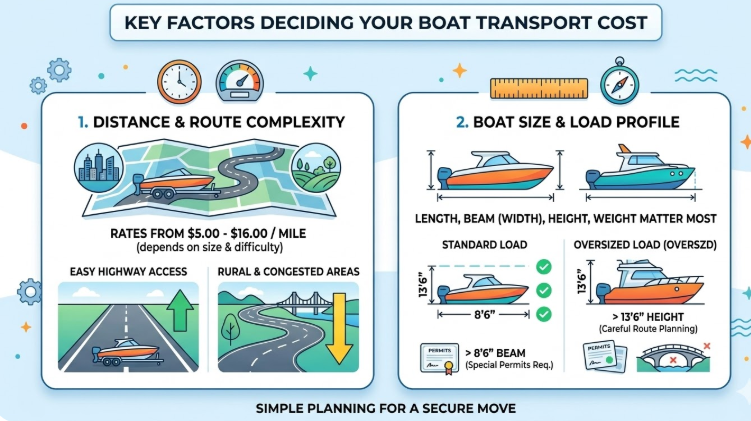
In 2025, moving a boat with Set Sail Boat Transport can cost anywhere from $5.00 to $16.00 per mile. The price can depend on multiple factors that we have discussed below. We recommend that you understand these aspects first before you decide to haul your boat.

6 Main Factors That Affect Boat Hauling Costs

Here are the six common factors that have an impact on calculating the boat hauling cost per mile. Being aware of them can help you plan and budget wisely.

1. Boat Size and Weight

The size and weight of your boat greatly impact the cost. Larger boats need more powerful trailers, sometimes specialized equipment, and extra handling, too. All of this increases the per-mile rate.

For example, a 25-foot sailboat may cost closer to $5 to $7 per mile, while a 40-foot yacht could range from $12 to $16 per mile.

2. Type of Boat

Different boat types also affect hauling costs. Sailboats, motorboats, pontoon boats, and houseboats all have different handling requirements. Sailboat transport commonly needs careful mast removal and securing, whereas motorboats may need heavier-duty trailers.

You must understand the type of boat you have to help us decide the safest and most affordable transport method.

3. Pick-Up and Delivery Locations

The location of pick-up and delivery is important. Boats that are picked up or delivered in urban areas with limited access may require extra handling or permits. This can raise costs.

If your pick-up or drop-off is in a remote area, it could increase the distance or require special equipment.

4. Special Equipment and Permits

We might need pilot cars, bucket trucks, police escorts, or special permits to follow road rules if your boat is oversized. These things keep your boat safe, but can add to the boat hauling cost per mile.

5. Insurance Coverage

Standard insurance normally covers the basic risks of moving your boat. But you might want extra cargo insurance if your boat is high-value. This adds a little to the boat hauling cost per mile, but it keeps your boat protected while we transport it.

6. Seasonal Demand

Boat transport prices change with the seasons. In spring and summer, demand is high, so rates are usually higher. In fall and winter, prices are often lower and more competitive.

Which Option Should You Choose Between Open and Enclosed Transport?

Another thing that affects cost is the type of transport you choose. Open or enclosed trailers.

Open Transport

This is the most common option and usually costs less. Your boat stays visible during the move, but it’s safe when we secure it properly. Open trailers work best for smaller boats or shorter trips.

Enclosed Transport

This gives extra protection from weather, road debris, and possible damage on long hauls. It costs more per mile but is a good choice for high-value or delicate boats.

The right choice depends on your boat’s size, value, and how comfortable you are with exposure. We at Set Sail Boat Transport can help you pick the best option for your needs.[/vc_column_text][vc_single_image image="1488" img_size="500x500" alignment="center" css=""][vc_column_text css=""]

Important Safety and Preparation Tips

Preparation StepKey Action/Tip
Remove Loose ItemsTake out all gear, electronics, and personal items from your boat.
Secure Hatches & EquipmentMake sure that hatches, doors, antennas, and masts are locked or strapped down.
Inspect TrailerCheck your trailer’s tires, lights, brakes, and hitch before the move.
Drain Fuel & FluidsKeep fuel at a quarter tank or less and make sure there are no leaks.
Document Boat ConditionTake clear photos of your boat for insurance purposes.
Measure Your BoatNote down your boat’s length, width, and height for transport.
Check Weather & SeasonPlan around bad weather and road restrictions to avoid problems.
Protect Sensitive AreasWrap delicate areas and clearly label any fragile parts.
Plan Pick-Up & Drop-Off AccessMake sure that trucks can access pick-up and drop-off points and remove obstacles.
Communicate Special InstructionsLet us know about any special features your boat has so we can handle them safely.

Why Choose Set Sail Boat Transport

Set Sail Boat Transport has a great track record for reliable, nationwide boat transport services with over 8 years of experience.

When you work with us, you get:

FAQs

[/vc_column_text][/vc_column][/vc_row][vc_row][vc_column][vc_tta_accordion][vc_tta_section title="1. How much do boat haulers charge per mile?" tab_id="1761943587137-13f70de8-a6d5"][vc_column_text css=""]We charge between $5.00 and $16.00 per mile. The price depends on your boat’s size, the route, and any extra services you need.[/vc_column_text][/vc_tta_section][vc_tta_section title="2. Are oversized boats more expensive to transport?" tab_id="1761943587149-0e81f191-4d34"][vc_column_text css=""]Yes. Boats that need pilot cars, police escorts, or special permits will cost more per mile.[/vc_column_text][/vc_tta_section][vc_tta_section title="3. How can I reduce my boat hauling costs?" tab_id="1761943702339-047ace76-c6c7"][vc_column_text css=""]You can save money if you are flexible with timing. Getting your boat ready before you leave also helps.[/vc_column_text][/vc_tta_section][vc_tta_section title="4. Should I use an open or enclosed trailer?" tab_id="1761943724549-1f15b3a8-783c"][vc_column_text css=""]Open trailers cost less and work well for regular boats and short trips. Enclosed trailers give more protection for high-value boats, but they cost more. Contact us today to get proper guidance.[/vc_column_text][/vc_tta_section][vc_tta_section title="5. Do seasonal changes affect cost?" tab_id="1761948595658-71027372-cf34"][vc_column_text css=""]Yes. Peak months like spring and summer have higher rates, while off-peak times can offer you more affordable prices.[/vc_column_text][/vc_tta_section][/vc_tta_accordion][/vc_column][/vc_row][vc_row][vc_column][vc_column_text css=""]

Ready to Transport Your Boat?

Knowing the boat hauling cost per mile in 2025 helps you plan your budget and saves you from unexpected charges. It also helps you pick the best way to move your boat.

We at Set Sail Boat Transport offer professional service for boats of all sizes. You can choose extra insurance, specific tools, and secure trailers to fit your needs.

Get in touch with us and get a free quote today for our boat transport services. We will handle your boat hauling with the best expertise, whether you are moving a small sailboat or a large yacht.[/vc_column_text][/vc_column][/vc_row]

Copyright 2025 © All Rights Reserved