Menu Links

[vc_row][vc_column][vc_column_text css=""]Boat transport is a task that demands the right equipment, experience, and planning. Thinking of it like a simple task of hooking up with your car and accelerating can be a big mistake, which can lead you to costly damage. Knowing the ins and outs before relocating any boat, including a mall fishing boat, a sailboat, or a luxury yacht, is a must.
In this detailed blog, we will cover everything from preparation and costs to choosing the right boat transport method and service provider, which will let you understand how to make your boat move as smooth as the open water. Being in a field for more than eight good years, we have seen so much. So, suit up and let’s dive into the deep!
The very first thought that comes to our mind when transporting a boat is, “I can do it by myself.” However, it is not a good idea because boats are expensive, fragile, and larger, which even sometimes become difficult for a transport company to handle.
Here are a few of the important details to look at and understand why hiring experts matters:
Boating is serious business. The USCG records over 550 deaths and thousands of injuries annually among recreational vessels, highlighting the importance of choosing the right company for boat transport is more than convenient.
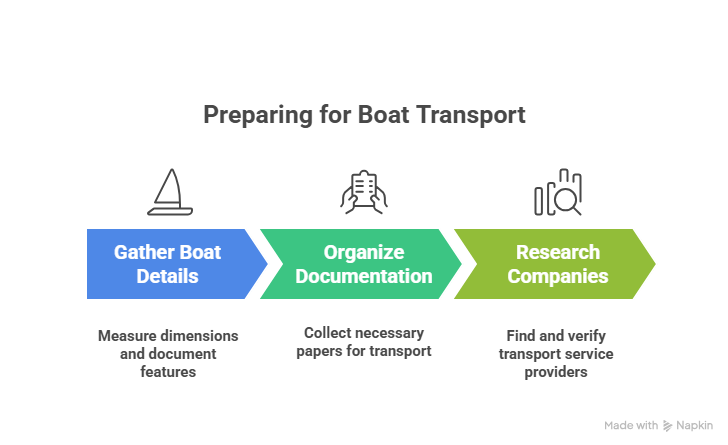
No matter what you do, preparation is the foundation of any work. The more accurate you are with details, the faster and safer your transport will be. Here are some steps that you can follow to be precise with your preparation:
The first thing you require is to measure the dimensions of your boat. It includes the length, width, height, and weight of the boat. After that, come on unique features, like masts for sailboats, radar towers, or removable accessories. Meanwhile, for insurance purposes, document scratches, dents, or other existing damage.
It’s necessary because at the time of boat transport, you may require any document; otherwise delay can happen in the work. Therefore, keep boat registration, insurance certificates. Permit, certificates required by states along the route, and contact information for marinas or drop-off points.
Start looking for companies with experience handling your specific type of boat. Shortlist the best ones and verify their licensing, insurance, and reviews on social platforms. Once you find it good, request that the company provide you with a detailed explanation of the transport process and timelines.
As you know, there are different types of boats, and not one generic solution fits them all. So, they require handling accordingly by knowing which service matches your vessel to ensure safe delivery.
Sailboats have tall masts and rigging, which takes a different approach compared to other types of boat transport. Transporting them often requires:
Relying on professional sailboat transport services means ensuring your sailboat arrives intact and minimizing risk during long-distance trips.
Fishing boats or dinghies are counted as small boats and are easier to move, but still require care. We need to secure the vessel properly on a trailer, along with following all the best practices.
Companies offering small boat transport services often provide cost-efficient options for shorter moves while maintaining safety standards.
Because of their size and full of amenities, luxury yachts require meticulous handling. For their hull support, professionals use custom cradles. Also, you may need escorts with it if the size falls into the oversized category. And to keep your investment safe, a full comprehensive insurance also becomes a must.
Specialized yacht transport services prioritize safety, real-time tracking, and minimizing any risk during cross-country or interstate transport.
If your boat uses a trailer, then it becomes critical that both the boat and trailer are transported with proper safety precautions. To achieve that, you need a secured trailer attached correctly to prevent swings, along with expert handling to reduce the risk of tires, axles, or suspension damage.
Reliable boat trailer services ensure both your boat and its trailer arrive safely without unnecessary wear or damage.
There are two choices you face while arranging boat transport.
It is a common option that is also cost-effective. With that option, you get your boat loaded on a flatbed truck, which doesn’t have an enclosure, and expose your vessel to bad weather conditions.
The other option is enclosed transport, which is also safe because on long routes, your boat remains safe from conditions like rain, dust, and road debris. If your boat is high-end and luxury, going with enclosed transport serves you well. It may look costly initially, but it justifies itself when it comes to protecting your investment.
Choosing from these two options is dependent on your boat type, distance, and value. If your boat is durable and the route is small, go with an open service; otherwise, an enclosed boat transport.
It is essential to understand boat transportation costs so you can manage your expectations accordingly. If the distance is long, it will cost you more. Boat size and permit requirements also count in the transport charges. And if there is extra equipment involved with the boat, that will also add to your charges. For your understanding, here is a rough cost breakdown:
| Boat Length | Less than 100 miles | 100-500 miles |
| Under 12 ft | $4.00 | $1.75 |
| 18–24 ft | $5.00 | $2.25 |
| 24–30 ft | $8.00 | $2.50 |
| 30–36 ft | $12.00 | $3.50 |
Costs per mile can range from $4.00 to $16.00, depending on route, boat size, additional escorts, and insurance needs.
When selecting a provider, consider these crucial factors:
Look for a company with experience in handling boats of your type. Along with that, see how professional they are with loading, securing, and balancing techniques.
Look for the safety measures by verifying the condition of trailers, cradles, and trucks, and also ensure that the equipment matches your boat’s dimensions and weight.
Request a detailed quote from a boat transport service so you don’t meet unexpected charges in the end, which can disturb your allocated budget. Keep in mind that cheap is not always good. To protect your boat and transport it safely, avoid providers who only offer vague estimates, and give weight only to all-inclusive quotes.
Last but not least, see whether the transport service provides timely updates and keeps you in the loop during the process. You can look for people's reviews to assess their communication and overall service. Choosing a company with a strong track record reduces the chances of surprises and ensures timely delivery.
No matter how best you are with your planning and preparation, some factors always remain out of the scope. Therefore, you need to be aware of delays if any of the following conditions arise:
When you rely on a professional transport company, feel relaxed because they are skilled at managing these unexpected situations and keep your vessel safe while minimizing downtime.
Once your boat arrives, look for the following things:
Following this simple practice ensures your boat is ready for use, maintains its long-term value, and protects you from facing unnecessary challenges.
To let you know what boat transport feels like in the real world, here are some scenarios:
Looking at these examples, you can understand how size, type, and distance influence transport strategy.
[/vc_column_text][/vc_column][/vc_row][vc_row][vc_column][vc_tta_accordion][vc_tta_section title="1. What is the cheapest option to transport a boat?" tab_id="1761943587137-13f70de8-a6d5"][vc_column_text css=""]The cheapest options are open carriers or flatbed trucks. They are suited for domestic transport and are most cost-effective. Also, short-distance small boats may be towed by the owner himself. However, international moves might require containerized or Roll on/Roll off (RoRo) shipping.[/vc_column_text][/vc_tta_section][vc_tta_section title="2. How much does it cost to transport a boat interstate?" tab_id="1761943587149-0e81f191-4d34"][vc_column_text css=""]Costs to transport a boat interstate vary because of distance and size. Also, things like permits, escorts, and insurance are included in the fees.[/vc_column_text][/vc_tta_section][vc_tta_section title="3. Why do yachts only sleep 12 people?" tab_id="1761943702339-047ace76-c6c7"][vc_column_text css=""]Yachts consisting of more than 12 passengers fall under the system of the SOLAS Convention. In that, stricter structural and safety regulations for passenger ships have become a requirement.[/vc_column_text][/vc_tta_section][vc_tta_section title="4. Can I track my boat during transport?" tab_id="1761943724549-1f15b3a8-783c"][vc_column_text css=""]Yes, if your transport company offers tracking service, you can get the ID from them and track it online throughout its transport.[/vc_column_text][/vc_tta_section][vc_tta_section title="5. Does the transport company clean my boat?" tab_id="1764012083400-1ebbd360-014f"][vc_column_text css=""]No, transport companies are only responsible for safe delivery. For cleaning, the owner can schedule it at the receiving marina to get the boat in a usable condition.[/vc_column_text][/vc_tta_section][/vc_tta_accordion][/vc_column][/vc_row][vc_row][vc_column][vc_column_text css=""]
Boat transport is not stressful if you are partnering with the right service provider. With careful preparation, understanding of options, and a reputable company, your vessel can reach its destination safely without any issues.
Meanwhile, if you want a partner who is experienced and trusted, Set Sail Boat Transport is at your service. We have been providing services for sailboats, small boats, yachts, and trailers for more than 8 years, and we ensure proper equipment, transparent pricing, and expert handling. To schedule your boat transport, give us a call or request a quote online. Happy boating![/vc_column_text][/vc_column][/vc_row]