
Menu Links
[vc_row][vc_column][vc_column_text css=""]Understanding budgeting for boat hauling rates is essential when it comes to transporting your vessel. The job is not to hire someone to move from here to there, but involves multiple factors like boat size and route that count in the final cost. Knowing these things in advance can let you allocate the hauling budget more precisely.
In this guide, we will discuss the main considerations, average cost ranges, practical tips, and service options so you do not encounter unexpected surprises while budgeting the move. So, let’s dive into the details!
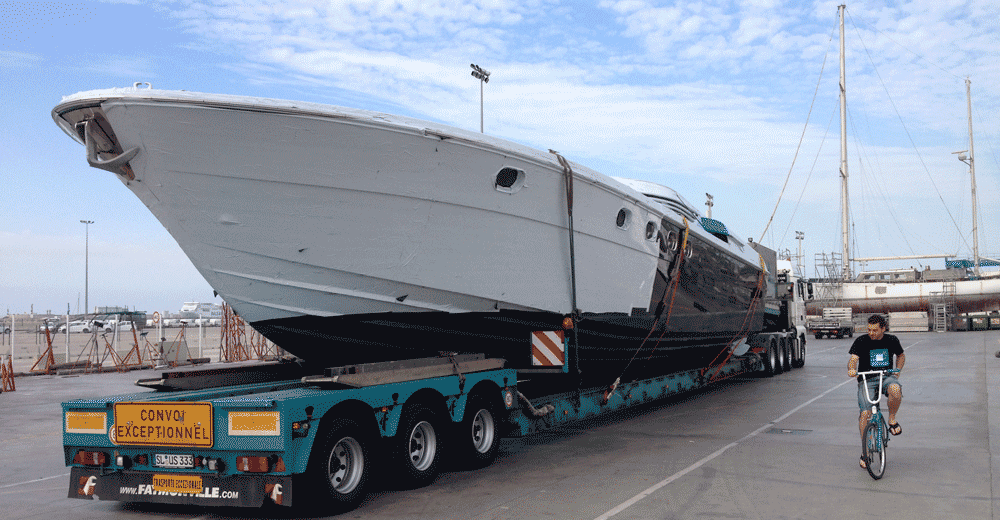
Boat hauling rates do not remain the same all the time and vary widely. For instance, if you have a small fishing boat, it may move across state lines for just a few dollars per mile. However, if you have a large yacht to move over a long distance, then it requires permits and pilot cars that can run into the hundreds per mile.
Further, the rates get influenced by factors like logistics, legal permits, and the specific needs of your boat. And it is also important to note here that while we aim to make timely deliveries, factors like weather delays, permit issues, and route changes cause delays because they are beyond our control, and preparing for these contingencies is a must when planning.
[/vc_column_text][vc_single_image image="1471" img_size="500x500" alignment="center" css=""][vc_column_text css=""]The boat transport costs depend on the following factors:
Keeping yourself aware of these factors allows you to understand why two similar-looking shipments can have different costs, while making your budget planning more precise.
The boat size is one of the dominating factors that determines the price. It plays a big role because a wider beam or taller boats require specific trailers, along with legal approvals. Here is how it goes:
Even a few inches of width increase in your boat can put it into the higher cost bracket. Therefore, when requesting quotes, measuring your boat, including beam, length, and height, is essential.
As we already mentioned, distance directly affects the quote because fuel and labor costs increase with it. Besides, the route characteristics play an equally important role here because overland transport for boats is not only about miles.
Look into the following factors for better clarity:
It is like if you are transporting a 30-foot powerboat from Florida to Texas, it may cost $2.00-$2.50 per mile, but these boat hauling rates can increase if the route includes tight mountain roads or bridge restrictions.
Heavy boats that are bigger than 40 feet require permits in many states. Along with that, some vessels need pilot cars or even police escorts to handle their transportation. These are included in a professional yacht transport service, but as separate line items, which you usually check mark when requesting a quote, like:
Clarifying which of these are included in your quote ensures you aren’t surprised by last-minute fees. Further, Federal guidance from the FHWA shows that states issue oversize/overweight permits for non-divisible loads, meaning that it would destroy the functionality if broken down. Also, note that national tracking of miles travelled under those permits is still not complete.
Loading and unloading impact both boat hauling rates and damage risk, and different companies handle this differently. Here is the basis of the process:
Here, you have to be very mindful because a little carelessness, like leaving a loose sail onboard, can increase the labor cost, along with high damage chances. Therefore, planning things beforehand protects your investment and reduces the final bill.
As mentioned previously, that season of spring or summer can hike the price, so you need to be aware of that when looking for a quote. Here, generally you will see a 10%-20% rise in the rate in the season time, while reduced rates in fall or winter.
Additionally, scheduling your boat hauling for a less busy season can also save money, but you have to ensure that the weather is safe for overland transport.
Here is a table mentioning average rates to expect when hauling a boat:
| Boat Size | Average Per-Mile Rate | Distance | Approximate Charges |
| Small boat. Less than 25 ft | $1.25-$5.00 | 200 miles | $250-$1,000 |
| Medium boat. Between 25-40 ft | $3.00-$10.00 | 300 miles | $900-$3,000 |
| Large yacht. Above 40 ft | $10.00-$16.00 | 400 miles | $4,000-$6,400 |
These rates include standard transportation but do not cover permits, pilot cars, or additional cargo insurance.
To get a precise quote, you need to follow the parameters as stated below:
If you own a fishing boat, dinghy, or other smaller boat, specialized small boat transport services can save money and simplify the process for you. With that, you get:
These services bring maximum efficiency without compromising safety.
Yacht transport services address challenges that are not present in a small boat. It includes:
All these are factors affecting pricing, including boat dimensions and route complexity.
You can rely on a boat transport service if you are looking for a mid-range solution that remains easy on your pocket, and caters to standard to oversized boats. Here is what you typically get with the general service:
If you want to save on your next boat hauling budget, keep the following things in mind:
These tips often reduce overall boat transport costs without compromising safety.
Even experienced carriers cannot control every variable. Therefore, you need to consider the following unexpected things that may appear while transporting your boat:
Despite all these challenges, professional boat hauling service providers communicate openly and help mitigate these issues. However, keep in mind that cleaning services are not included in this, as boats often get dusty or wet during cross-country transport. Therefore, scheduling cleaning at the receiving marina is recommended.
Insurance is the area that is often overlooked when budgeting for boat hauling. Even with experienced haulers and well-maintained equipment, accidents can happen because of debris on the road or sudden weather shifts. Therefore, understanding how your boat is protected during transport can prevent inconvenience later.
Besides, reputable carriers provide a baseline level of cargo insurance, but it may not cover the your boat full value. So, before your boat moves, ask for proof of insurance and clarity on things that are covered in insurance. Also, check your marina or storage facility requirements, as some require proof of liability coverage before releasing or accepting a vessel.
Finally, take detailed photos before pick-up, record the hull, propellers, and any visible equipment to create a verifiable record in case damage occurs during transit. Remember, insurance is not only paperwork but turns an unpredictable process into a managed one.
[/vc_column_text][/vc_column][/vc_row][vc_row][vc_column][vc_tta_accordion][vc_tta_section title="How much does it cost to have a boat hauled?" tab_id="1761943587137-13f70de8-a6d5"][vc_column_text css=""]The cost of boat hauling depends on the size, distance, and complexity. For an idea, a 20-foot fishing boat can cost $1.50–$2.00 per mile, and a 30-foot powerboat $2.00-$2.50 per mile.[/vc_column_text][/vc_tta_section][vc_tta_section title="What is the 10% rule for yachts?" tab_id="1761943587149-0e81f191-4d34"][vc_column_text css=""]The 10% Rule suggests budgeting 10% of your yacht's purchase for yearly maintenance and running costs. For instance, if your yacht costs you $500,000, then you roughly need $50,000 per year for its maintenance.[/vc_column_text][/vc_tta_section][vc_tta_section title="How do you get rid of a non-running boat?" tab_id="1761943702339-047ace76-c6c7"][vc_column_text css=""]You get rid of it by selling, donating, recycling, or disposing at a local landfill.[/vc_column_text][/vc_tta_section][vc_tta_section title="Can I transport a boat myself?" tab_id="1761943724549-1f15b3a8-783c"][vc_column_text css=""]Yes, but doing transport by yourself is risky. Using a professional boat transport service is safer because they have permits, insurance, trailers, and experience. Besides, they provide cost-effective solutions that are also convenient.[/vc_column_text][/vc_tta_section][/vc_tta_accordion][/vc_column][/vc_row][vc_row][vc_column][vc_column_text css=""]
Planning for boat hauling rates is not difficult if you follow the steps and precautions we discussed above. Meanwhile, the typical costs range from $5.00 to $16.00 per mile, depending on boat size, distance, and additional requirements. And proper preparation, like measuring boat beam, securing loose items, and choosing the right service, can prevent costly mistakes.
So, for those seeking reliable nationwide coverage, we at Set Sail Boat Transport are experienced carriers with over eight years of boat transportation experience. We treat your boats as our own, and that is why many owners trust us with their investment. We move your vessels safely, efficiently, and on schedule, whether it’s a small boat or a luxury yacht.[/vc_column_text][/vc_column][/vc_row]