Menu Links
[vc_row][vc_column][vc_column_text css=""]You should be careful when thinking about boat shipping coast-to-coast. It can get heavy on your budget if you don’t have the right information.
It is a long journey, roughly 2,200 to 2,800 miles. You need to understand the cost to ship a boat from Florida to California and the factors that can cause the pricing to fluctuate.
At Set Sail Boat Transport, we have handled many cross-country boat moves, and we know what it takes to calculate costs, secure permits, and make sure that your boat arrives safely.
In this guide, we will explain pricing, compare trailer transport types, and go through state-specific rules.
Before we talk about the boat transport cost, we need to first understand what really influences it.
We all know that distance is the main thing to consider, but apart from that, what are the other factors that affect the cost to ship a boat from Florida to California?
On average, the rates can range from $5 to $16 per mile according to all these factors.
We have written down sample estimates based on boat size and transport complexity to give you an idea:
Rate per mile: $5 to $6
It will cost you $12,500 if your boat travels 2,500 miles.
Rate per mile: $7 to $10
It will cost you between $17,500 and $25,000 if your boat travels 2,500 miles.
Rate per mile: $10 to $16
It will cost you between $25,000 and $40,000 if your boat travels 2,500 miles.
These are just rough figures. Of course, the cost depends on your boat’s size, permits, insurance, etc., but there are more factors that affect actual costs. We have discussed them for you below.
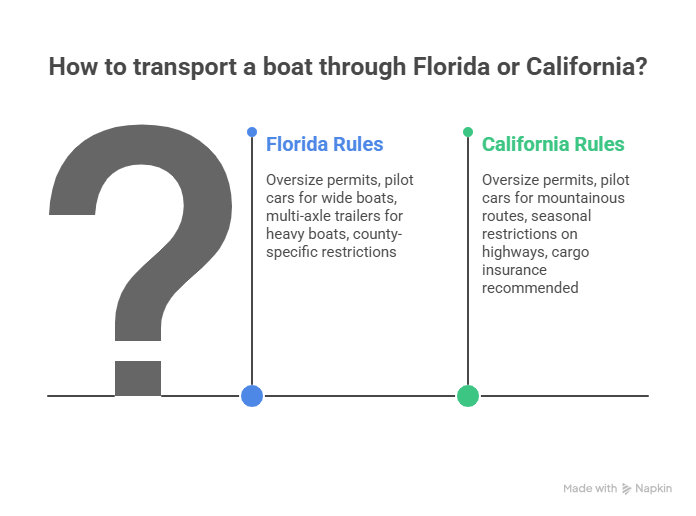
Knowing the rules of both Florida and California will help you understand how the cost is calculated and where you might need to pay extra. Let's quickly go through the points:
Choosing the right boat trailer type can affect both cost and safety. Here’s a quick comparison:
Open transport is a popular choice for many boat owners because it’s more affordable and easily available, and it also gives you faster scheduling. It’s a practical option when you want to move your boat quickly and without going over your budget.
But it does have a few downsides. Your boat remains exposed to weather, debris, and road dirt throughout the trip. This brings a little bit of risk of minor cosmetic damage.
Overall, this method works best for small- to mid-size boats, aluminum boats, or sailboats with removable rigging.
Enclosed transport gives your boat the highest level of protection during transit. It covers your vessel from weather, road debris, and even minor bumps that can happen along the way. This option is the best for luxury yacht transport or boats with sensitive electronics.
The only drawback is the cost. Enclosed transport is more expensive, and it may require specialized equipment to handle larger or custom builds.
Still, it’s the top choice for high-value boats, large sportfishing yachts, or vessels that demand extra care.
Choosing between the two really comes down to your budget, the value of your boat, and how much risk you are willing to take. At Set Sail Boat Transport, we help you pick the best transport option according to your vessel’s size, build, and handling needs.
[/vc_column_text][/vc_column][/vc_row][vc_row][vc_column][vc_tta_accordion][vc_tta_section title="1. How does Set Sail Boat Transport handle oversized boats?" tab_id="1761943587137-13f70de8-a6d5"][vc_column_text css=""]We carefully pick the right trailer according to your boat’s measurements. Every oversized transport receives a customized plan designed for safety and compliance.[/vc_column_text][/vc_tta_section][vc_tta_section title="2. What kind of communication can I expect during transport?" tab_id="1761943587149-0e81f191-4d34"][vc_column_text css=""]When you book a boat move with us, you’ll get regular calls, texts, and photo updates showing pickup, progress, and delivery status. Our goal is to keep you fully informed every step of the way.[/vc_column_text][/vc_tta_section][vc_tta_section title="3. What are the average costs for the boat towing service?" tab_id="1761943702339-047ace76-c6c7"][vc_column_text css=""]Prices depend on your boat size, route distance, and the type of transport service you choose. On average, boat towing might range between $5.00 and $16.00.[/vc_column_text][/vc_tta_section][vc_tta_section title="4. How long does a boat transport usually take?" tab_id="1761943724549-1f15b3a8-783c"][vc_column_text css=""]The duration of your transit can vary depending on the route, the distance your boat needs to cover, and the weather conditions. We provide an estimated delivery time before the trip begins and keep you updated throughout the journey.[/vc_column_text][/vc_tta_section][/vc_tta_accordion][/vc_column][/vc_row][vc_row][vc_column][vc_column_text css=""]
When it comes to finding the best boat towing service, you should look for expertise, strong safety standards, and transparent communication. At Set Sail Boat Transport, we’re proud to meet those expectations and exceed them.
Our team is veteran-owned and dedicated to transporting each boat with care and precision. We value your boat as much as you do. Contact us today and let our experienced team make your next boat move simple, safe, and worry-free.[/vc_column_text][/vc_column][/vc_row]