Close
a quiet harbor, your boat’s security depends entirely on the connection between your ground tackle and the seabed.
A reliable anchor guide helps you understand which anchor design, weight, and setup will keep your vessel firmly in place when wind, tide, or currents begin to shift.
At Set Sail Boat Transport, we work with vessels of every size and configuration. While our specialty is safe overland hauling, we know that strong seamanship begins with proper equipment choices.
Let’s understand how anchors generate holding power and allow you to choose the right setup for your boating environment and travel plans.
One principle in anchoring that is usually ignored is the role of the chain and rode in maintaining horizontal tension. Anchors perform best when the pull along the shank remains close to horizontal rather than vertical.
This happens through the natural curve created by the weight of the chain, often called the catenary effect. The curve absorbs wave shock and keeps the anchor buried in the seabed.
For example, when you deploy sufficient scope, typically five to seven times the water depth, the chain forms a heavy arc along the bottom. This arc ensures that the anchor digs deeper rather than lifting out during strong gusts.
This anchor guide approach emphasizes that the anchor itself is only part of the system. Without adequate chain weight and proper rode length, even the most advanced anchor design can lose its grip.
The most important factor when selecting an anchor is the type of seafloor where you typically boat. Sand, mud, rock, and grassy bottoms all require different designs to achieve maximum holding strength.
Below is a quick comparison of commonly used anchor types.
Anchor Type | Ideal Seabed | Key Advantage | Possible Limitation |
Fluke (Danforth) | Sand and mud | Excellent holding power for its weight | Can struggle in rocky areas |
Plow (CQR / Delta) | Mixed seabeds | Reliable resetting ability | Slightly heavier for the holding power |
Scoop (Rocna / Mantus) | Most conditions | Very strong bite and fast setting | Larger size on bow rollers |
Grapnel | Rocks and reefs | Hooks onto hard structures | Weak performance in sand |
Mushroom | Soft mud or silt | Creates a suction hold | Best for small or permanent moorings |
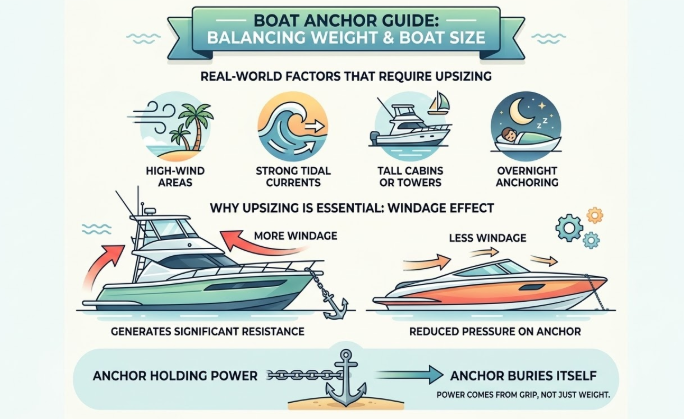
Many boat owners assume that heavier anchors automatically provide better security. In reality, holding power comes from how effectively the anchor buries itself rather than from weight alone.
Anchor manufacturers typically publish sizing charts based on boat length and displacement. However, several real-world factors can require upsizing:
For example, a cruiser with large topside structures generates significant wind resistance. That additional pressure pulls against the anchor harder than a low-profile boat of the same length.
Anchoring strategy becomes more critical when wind speeds increase or storms approach. Relying on a single anchor may not provide enough security in extreme conditions.
Experienced boaters use specialized setups such as:
Two anchors are connected along the same rode to increase holding power. The forward anchor digs deeper while the second distributes the load.
Two anchors are placed 180 degrees apart. This method reduces swinging when tides reverse.
Two anchors are set at a wide angle from the bow. This configuration stabilizes the boat and prevents excessive movement.
In this anchor guide, we encourage carrying at least two different anchor types so you can adapt to changing environments and weather conditions.
Your anchor may be essential on the water, but during road transport, it can become a heavy hazard if not secured properly.
Anchors mounted on bow rollers can shift due to road vibration, potentially damaging the hull or pulpit hardware. For this reason, we recommend removing the anchor and storing it inside a locker or secured compartment before long-distance hauling.
When we coordinate sailboat transport, we see large galvanized anchors that weigh over 60 pounds. Securing this equipment properly prevents stress on the bow structure and protects the boat’s finish during transit.
Treating your ground tackle carefully during transport ensures it remains ready for use when your vessel reaches its next destination.
A dependable anchoring system is one of the most important safety tools on your boat. When you follow our comprehensive anchor guide, you gain confidence that your vessel will remain secure whether you are stopping for lunch or anchoring overnight in a remote cove.
By choosing the correct anchor style, deploying proper scope, and preparing for changing conditions, you create a reliable connection between your boat and the seabed.
Are you ready to relocate your vessel to a new cruising ground where you can test out your new ground tackle? At Set Sail Boat Transport, we specialize in safe and efficient boat transportation so you can focus on the journey ahead.
Reach out now for a personalized boat transport plan and spend more time enjoying your adventures on the water.