Close

[vc_row][vc_column][vc_column_text css=""]When you need to move your sailboat across states, determining sailboat transport rates is the first step to avoid any surprises. Whether you are relocating, selling, or preparing for the winter season, knowing how these rates are calculated can save you from costly inconvenience.
Factors like distance, the size and weight of your boat, and the type of equipment required can bring the price up from a few hundred to several thousand dollars. However, if you understand the process beforehand, it saves you from problems.
[/vc_column_text][vc_single_image image="1475" img_size="500x500" alignment="center" css=""][vc_column_text css=""]There is no standard fixed rate for boat shipping, but there are some constant factors that every hauler considers when calculating the cost of transporting your sailboat:
The size of your boat is one of the biggest cost influencers in transport. The larger your boat is, the more time, labor, and handling it takes. Further, you cannot overlook the beam width while requesting a quote because it can require getting special permits or even escort vehicles.
For example, a 30-foot sailboat with a wide beam may require an extended trailer or pilot cars, while a compact 22-foot cruiser can often fit standard transport setups.
Longer trips often have a slightly lower cost per mile because carriers can get enough margin on long routes. That is why a 300-mile haul might cost less per mile than a 1,200-mile trip, but the total still is higher in the longer trip. Further, if your route crosses mountain ranges, narrow bridges, or busy metro areas, expect minor surcharges.
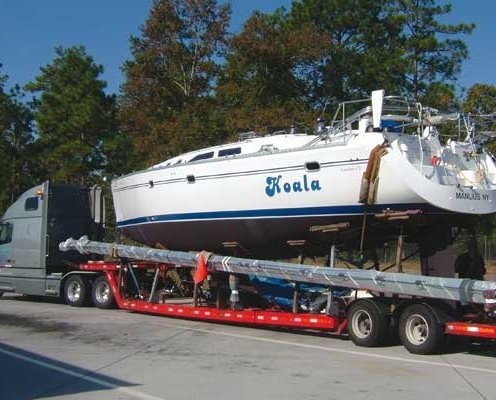
When you transport a boat, it’s usually done via truck and trailer, which we call overland transport in our industry term. This comes as the most common option because an open trailer is ideal for smaller or mid-sized sailboats, while a specialized cradle or carrier is required for larger boats.
If you’re planning to move a smaller vessel or trailerable sailboat, consider checking out a small boat transport service because it can be more affordable and faster to schedule.
In general, ranges between $1.50 and $4.00 per mile for standard road shipping. But depending on your boat size, location, and timing, that number can go as high as $5.00 to $16.00 per mile. Here is a breakdown to give you an idea:
| Boat Length | Average Weight | Distance | Estimated Price |
| 20 ft | 3,000 lbs | 500-mile trip | $750-$1,000 |
| 30 ft | 8,000 lbs | 800-mile trip | $2,500-$3,500 |
| 35 ft | 10,000-15,000 lbs | 1,200-mile trip | $4,500-$6,500 |
For your knowledge, there are around 11.96 million registered recreational boating vessels in the US. And seeing that number, it is easy to estimate why sailboat transport rates fluctuate across regions and seasons.
Most transport companies won’t move your vessel unless it’s ready to load. Here is what that means:
Also, note that transport companies don’t offer cleaning services. So, after a long boat hauling trip, your vessel will probably arrive dusty and require cleaning or detailing at your destination marina.
If you are still unsure what level of prep is required, a reputable sailboat transport service provider can walk you through it step-by-step.
Boat transport companies require special equipment, experience, and insurance coverage. Look for companies that:
However, delays can still happen because no company has control over the weather conditions, construction zones, or unexpected road closures. But in such situations, the right partner gives you transparency and peace of mind that your vessel is handled safely from dock to dock.
For general guidance or broader shipping needs, you can explore boat transport services that handle multiple vessel types across nationwide routes.
Here are a few extras that can influence the cost to ship:
Besides, if your route is a long distance, plan ahead for seasonal fluctuations. And the bottom line is always get multiple quotes and compare service details, not just price, because the cheapest is not always the safest.
[/vc_column_text][/vc_column][/vc_row][vc_row][vc_column][vc_tta_accordion][vc_tta_section title="What is the cheapest way to transport a boat?" tab_id="1761943587137-13f70de8-a6d5"][vc_column_text css=""]The cheapest way is usually open-trailer overland transport during off-peak seasons. Smaller boats that can fit standard trailers may even be towed by the owner if the vehicle allows it.[/vc_column_text][/vc_tta_section][vc_tta_section title="Can a 30-foot sailboat cross the Atlantic?" tab_id="1761943587149-0e81f191-4d34"][vc_column_text css=""]Yes, many 30-footers can reach safely if they are properly equipped. However, for relocations within the U.S., overland shipping is far safer and simpler.[/vc_column_text][/vc_tta_section][vc_tta_section title="Can a regular car tow a boat?" tab_id="1761943702339-047ace76-c6c7"][vc_column_text css=""]No, you need a truck or SUV with the right towing capacity for a boat.[/vc_column_text][/vc_tta_section][vc_tta_section title="How long does sailboat transport take?" tab_id="1761943724549-1f15b3a8-783c"][vc_column_text css=""]A few hundred miles may take two to three days; cross-country transport can take a week or more, depending on weather and permits.[/vc_column_text][/vc_tta_section][/vc_tta_accordion][/vc_column][/vc_row][vc_row][vc_column][vc_column_text css=""]
Shipping a sailboat is not about reaching from one place to another at the minimum price. It is about doing it safely, with reliable sailboat transport rates. Planning a budget while considering your investment safety helps you choose a company that values both precision and professionalism to move your boat.
At Set Sail Boat Transport, we have spent over eight years helping owners manage boat haulings. Our team specializes in secure overland hauling with clear communication, insurance-backed service, and on-time delivery whenever possible.[/vc_column_text][/vc_column][/vc_row]